Showing posts with label School Cafeteria POS Software. Show all posts

Saturday, 21 May 2016

Give Schools the Tools to Solve Cafeteria Challenges

Jessica Donze Black Director, The Pew Charitable Trusts’ child nutrition project


Tyrone Turner: Courtesy of the Robert Wood Johnson
Across our nation, students are settling into back-to-school routines. Between their daily lessons in math, science and reading, there’s another subject important to their academic success but often overlooked and not found on their report cards: nutrition.

Yes, it’s time to talk about lunch.
Directory Listings Now
Each day more than 30 million American students get their midday meals at school. For much of the last three decades, as the nation’s childhood obesity rate surged, school meals weren’t as healthy as they could have been. But thanks to updated school nutrition standards issued by the U.S. Department of Agriculture in 2012 — and the work of innovative nutrition professionals — cafeteria menus are now healthier than ever.
Today, every school lunch includes a serving of fruit or vegetables plus lean protein and foods rich in whole grains. Nearly one-third of schools have self-serve salad bars. And the stronger national nutrition standards have reduced geographic and demographic differences: Before the standards were updated, teenagers at larger schools or campuses with predominantly white enrollments were more likely to have healthy options on daily menus than students at smaller or more racially and ethnically diverse schools. But now, the smaller and more diverse schools have increased their offerings of nutritious items enough to close the gap.
Studies from Connecticut to Texas confirm what many school nutrition professionals are seeing in their lunchrooms. Under the healthier meal standards, more children are choosing and eating fruit and consuming more of their entrees and vegetables, increasing their nutrient intake and decreasing food waste. Parents and students alike support the healthier meals.
But like any classroom, successful nutrition programs and education require the right tools and professional training. Both are in too short supply. As Congress works on a five-year reauthorization of the Child Nutrition Act this fall, members should make greater support for training and new equipment a top priority.
When the updated meal standards took effect in 2012, The Pew Charitable Trusts and the Robert Wood Johnson Foundation surveyed school meal program administrators nationwide and found that 88 percent of districts reported needing at least one new piece of kitchen equipment to serve healthier meals, such as ovens to cook baked potatoes and large-capacity slicers to cut fruit and vegetables. Almost two-thirds reported staff training needs, but only 37 percent said they had the necessary funding to provide the training.
The bipartisan School Food Modernization Act, pending in both chambers of Congress, would address these obstacles to healthy, efficient meal programs. The legislation would help schools obtain loans and grants to finance kitchen updates and training for food service professionals. For a while, Congress has appropriated about $50 million in recent years to help schools purchase new kitchen equipment, availability of these resources has been irregular and limited to a fraction of the almost 100,000 schools in the United States. The modernization bill would bring improved access and predictability for schools seeking assistance with equipment upgrades and staff training.
The difference made by these investments is tangible. Anna Fisher, director of food and nutrition services for the Mount Diablo Unified School District, about 30 miles east of San Francisco, recently made use of a federal grant to help purchase a new serving line that allows students to choose their own food from a display. “We’ve seen that when the children select their own food, less food gets thrown away,” Fisher reports. The grant also helped her district procure a walk-in refrigerator that lets the staff store and serve twice as much fresh produce while reducing energy costs.
It’s clear why large majorities of voters who have children in public schools, as well as adults nationwide, want to maintain the policies spurring this progress. According to the Centers for Disease Control and Prevention, healthy kids learn better. As Congress continues to evaluate the successes and challenges of the Child Nutrition Act, the debate should not be over whether to require that school meals include healthy food. Instead, lawmakers should look at how far schools have come and build on the programs that are working so well.


Sunday, 15 May 2016

Hastings Public Schools ensures students have breakfast option

Children at Hastings Public Schools have the option to eat breakfast every day of the school week at school.
The problem, according to district director of finance Jeff Schneider, is the logistics if every student chose to take advantage of the program.
“We’d have to start serving breakfast at 6:30 in the morning to get everyone served,” he told the Hastings Tribune.
Both Hastings and Adams Central public schools offer a breakfast program to all students, both those who pay full price and those participating in the free or reduced lunch program. And while all students have the option, only a small percentage of students in both districts partake.
A report recently released by the Food and Research Action Center ranked Nebraska 49th out of all states and the District of Columbia in participation of eligible children able to receive breakfast at school. The Nebraska School Breakfast Challenge was created in early2012 as a way to encourage an increase in the number of students served across the state. Schneider said the school district always encourages children to have breakfast every day, whether that be at school or home.
The district provides a hot breakfast at all school sites along with cereal, fruit, juice and milk. In January, a total of 13,299 breakfasts were served across the district with about 12,000 of those served to students who qualify for the free or reduced lunch program. Those students also pay a reduced rate or receive their breakfast for free.
The number of breakfasts served is about a quarter of the 53,000 lunches served during the same time period.
“What we’ve found is it just depends on what peoples’ schedules are,” Schneider said. “For some people, it works great for their kids to go eat breakfast at 7:45-7:50 a.m. For other people, it just doesn’t.”
Jennifer Pohlson, the principal at AC’s Juniata Elementary, said she agrees that for some students and parents the breakfast program works well.
There are many students who would have to eat breakfast very early to fit into their parents’ schedule and that would mean a longer wait until lunch. With the breakfast program, Pohlson said students can eat and not have to worry about being hungry in their morning classes.
“It’s crucial that they have breakfast, otherwise they’re sitting in class thinking about their stomachs growling and about being hungry instead of concentrating on what they’re supposed to be concentrating on,” she said. “We just need brain food to be able to learn.”
When the school is in the middle of state testing, Pohlson said they will even provide all students with small snacks to help ensure they are concentrating on their work and not their stomachs.
In the Adams Central district, food service manager Angie Nissen ensures there is cereal, yogurt, milk, juice and granola bars or other snacks available for the cold breakfast at each of the three elementary schools.
The middle and high school students have the option of a cold or hot breakfast at the high school where Nissen and the staff serve everything from breakfast pizzas to pancakes and sausage.
“We even do biscuits and gravy,” she said. “That’s one of their favorites.”
At the high school, Nissen said about 50 students take advantage of the breakfast each morning along with other students who purchase a la carte items, including bottled water and juice, cookies, fruit and granola bars.
“We start serving at 7:30-7:40 a.m. and we don’t usually close until the last bell rings,” she said. “Some kids will straggle in and get their water or whatever else they need before class.”
The number of students served is less in the elementary buildings, where 15-20 is the norm. At Hastings Public, Schneider said he’s glad that the number of students served isn’t huge. That’s because it could cause as scheduling nightmare.
Lunchtimes are staggered each day to get all students through the cafeteria in each of the buildings. If all students also ate breakfast, Schneider said students would have to start eating at 6:30 a.m. or sooner.
That’s not to say Schneider doesn’t think the district should serve breakfast. In fact, he thinks the numbers increase a bit in the winter time as students arrive to school early and decide it would be nicer to eat a warm breakfast in the building rather than waiting out in the cold for the bell to ring.
“And it’s there for those that want or need it,” Schneider said. “We don’t turn anybody away.”

Wordware School Lunch Software

Tuesday, 3 May 2016

Have a question, or comment?

Want more information about Wordware’s Lunch Cashier System or would like to schedule a demo? Would you like to provide feedback or just need some help in general? Please feel free to call us, email us, or fill out the form below and we will get back to you as quickly as possible.

http://wordwareinc.com/contactus.php

How School Lunch Became the Latest Political Battleground

Sarah Anne Ward for The New York Times. Food Stylist: Maggie Ruggiero. Prop Stylist: Maeve Sheridan.
The lunch ladies loved Marshall Matz. For more than 30 years, he worked the halls and back rooms of Washington for the 55,000 dues-paying members of the School Nutrition Association, the men and still mostly women who run America’s school-lunch programs. They weren’t his firm’s biggest clients — that would have been companies like General Mills or Kraft — but Matz, wry and impish even in his late 60s, lavished the lunch ladies with the kind of respect they didn’t always get in school cafeterias. Many of the association’s members considered him a dear colleague. “He would tell everybody: ‘You are a much better lobbyist than I am. You are how we get things done,’ ” said Dorothy Caldwell, who served a term as the association’s president in the early 1990s. “And people liked that.”
Matz often told the lunch ladies they were front-line warriors in the battle for better eating, and they liked that too. Every school day, they dished out more than 30 million lunches, all of which were subsidized by taxpayers. They also served about 13 million subsidized breakfasts. Many students got more than half their daily calories at school. Few workers, inside the government or out, did more to shape the health of children.
So when Michelle Obama started Let’s Move!, her campaign against child obesity, in 2010, the members of the School Nutrition Association were her natural allies. The average weight of the American child had been climbing at an alarming rate since the 1980s, and now one in three American kids was obese or overweight. One recent study found that by 2030 more than half the adult population would be dangerously overweight, leading to millions of cases of diabetes, stroke and heart disease. Researchers at the Institute of Medicine, meanwhile, were finishing new recommendations to bring school meals into compliance with national dietary guidelines, and Congress was about to reauthorize the school-lunch program. This gave the White House an opening. If there was a war to fight against childhood obesity, then school cafeterias would be a perfect place to wage it.
That year, the Obama administration got behind the Healthy, Hunger-Free Kids Act, an ambitious bill that would impose strict new nutrition standards on all food sold in public schools. A generation raised on Lunchables and Pizza Hut, the bill’s authors believed, could learn to love whole-wheat pasta and roasted cauliflower. Kids would be more energetic, better able to focus in class and above all less likely to be obese. But to pass the bill, the White House needed to enlist not only Democrats and Republicans in Congress but also a host of overlapping and competing interest groups: the manufacturers who supplied food to schools, the nutrition experts who wanted it to be more healthful and the lunch ladies who would have to get children to eat it.
Few people understood how to accomplish those trade-offs better than Marshall Matz, in part because he embodied them. He spent his early career advising Senator George McGovern, a Democrat who led efforts in the 1970s and 1980s to defend and expand federal nutrition programs. Matz worked for major food interests, but he still considered himself a nutrition advocate. He advised the Obama campaign on agricultural issues and even helped one of the School Nutrition Association’s former presidents get a post in the new administration. He prized his access to the White House but believed deeply, his friends in Washington told me, that bipartisanship in Congress was what allowed the school-lunch program to endure.
To Matz, it seemed clear that a bargain could be struck. He advised the lunch ladies — a term that almost nobody in Washington uses in public and almost everyone uses in private — to support the legislation, even though it did not provide as much money as they wanted. Under pressure to show concern about child obesity, food companies backed it, too: With $4.5 billion in new funding over the next 10 years, the bill did provide plenty of new business, and their lobbyists could always massage the details later. The Healthy, Hunger-Free Kids Act became law in 2010, with overwhelming support in Congress.
But as the government began turning the broad guidelines into specific rules — specific rules with specific consequences for specific players — life became more difficult. What began as a war on obesity turned into war among onetime allies. Republicans now attack the new rules as a nanny-state intrusion by the finger-wagging first lady. Food companies, arguing that the new standards are too severe, have spent millions of dollars lobbying to slow or change them. Some students have voted with their forks, refusing to eat meals they say taste terrible.
Last summer, the School Nutrition Association dumped Matz. In the small world of Washington food lobbyists, the decision provoked unending gossip and speculation. Matz said little about the sudden turn, even to friends. “I was not happy,” Dorothy Caldwell recalled. Several longtime members pressed the association’s professional staff for more information with little luck, and the answer soon became clear to them: The lunch ladies were taking sides, too.
Today the School Nutrition Association is Washington’s loudest and most public critic of the Healthy, Hunger-Free Kids Act. Even as they claim to support the act, the lunch ladies have become the shock troops in a sometimes absurdly complex battle to roll back the Obama’s administration’s anti-obesity agenda. Some Democrats in Congress fear that if Republicans win control of the Senate this fall, Obama’s reform will be gutted within a year — and with it, the government’s single-best weapon against childhood obesity. “It’s a war of attrition at this point,” one congressional aide told me. “Right now we’re in that phase where you’re fighting a rear-guard action to hold on to as much territory as you can.”
The federal school-lunch program has always invited martial metaphors, and not without reason: It was the U.S. military that first advanced the national-security implications of a healthful lunch. In the spring of 1945, at the dawn of the Cold War, Gen. Lewis B. Hershey, a former school principal who joined the armed forces before World War I, went in front of the House Agriculture Committee to deliver a stern warning. Hershey headed the Selective Service System — the draft — and he told the lawmakers that as many as 40 percent of rejected draftees had been turned away owing to poor diets. “Whether we are going to have war or not, I do think that we have got to have health if we are going to survive,” he testified.
Within a year, a majority of lawmakers from both parties had voted for the National School Lunch Act. The act declared it “the policy of Congress, as a measure of national security, to safeguard the health and well-being of the nation’s children.” In the way of many programs inspired by the Department of Defense, the School Lunch Program grew in large part because it offered something to everyone. Over the coming decades, the Department of Agriculture would send billions of dollars to states and school districts to help cover the costs of school meals and spend billions more to purchase surplus farm products for the schools. The program was expanded significantly under Richard Nixon, who sought to ensure that poor children got their school lunches free, and by the mid-1970s it fed 25 million kids.
Jimmy Carter made minor cuts to school-lunch subsidies in his last year in office, and Ronald Reagan, arguing that government shouldn’t subsidize meals for children who could afford to pay, made even deeper cuts. His administration also modified the dietary requirements: Among other changes, some condiments could be credited as vegetables. Opponents of the cuts quickly pointed out that, under the regulations, even ketchup could qualify — an observation that led to considerable derision in the press.
Photo
Credit Sarah Anne Ward for The New York Times. Food Stylist: Maggie Ruggiero. Prop Stylist: Maeve Sheridan.
The condiment rule did not last, nor did Reagan’s cuts. But they did help accelerate a major transformation in how schools provided food. Most districts require food service to earn enough revenue to cover expenses, including labor. The average school-nutrition director is not unlike the chief executive of a medium-size catering business, but with a school for a landlord and a menu regulated by the government. With lower subsidies, the lunch ladies needed cheaper calories, and they turned to the increasingly efficient processed-food industry to find them. School cafeterias also began to rely more on revenue from so-called competitive foods — snacks and lunches that are not regulated by federal guidelines and “compete” with the regular school lunch on cafeteria à la carte lines. Some districts even struck deals with McDonald’s, Chick-fil-A and other fast-food chains to sell versions of their commercial products directly to school kitchens.
The kids loved it — and so, more or less, did the lunch ladies. The food industry made their programs hum, made it possible to serve hundreds or thousands of meals, often without working kitchens, in lunch periods as short as 25 minutes. Big food companies became partners in every way: Most held associate memberships in the School Nutrition Association and helped finance it with industry advertising and membership fees.
Nutritionists were less happy with the status quo. Instead of exposing children to a variety of foods, school lunches tended to indulge their cravings. There were plenty of white rolls and French fries but not many leafy dark greens or whole grains. Even after many school-food companies made strides in reducing fat and salt in their products, the average school lunch in 2009 still contained 1,375 milligrams of sodium, almost twice as much as federal dietary guidelines recommend for a single meal. Worst of all, competitive foods — most often desserts, salty snacks and pizza — were adding an extra 277 calories a day to the diets of the children who bought them.
In one sense, the school-lunch program was all too successful. No longer was the military having trouble finding well-fed young American men and women. By 2009, according to the Department of Defense, more recruits were being turned away for obesity than for any other medical reason. The recruits, as a letter signed by dozens of retired generals and admirals put it, were “too fat to fight.”
The first shot in the Cafeteria Wars was fired in January 2011. That was when, under the terms of the new law, a team of dietitians, economists and nutritionists at the Department of Agriculture released the revised meal pattern for school breakfasts and lunches. The rules outlined just what schools — and, by extension, their suppliers — would have to do to continue receiving government subsidies. Both groups were struck by just how aggressive the new rules were. Within a few years, schools would need to switch all of their breads and pastas to whole-grain varieties. Within a decade, the average salt content of a high-school lunch would have to be cut by roughly half. When the school year began in fall 2012, lunches would have to offer twice as many fruits and vegetables, and students would be required to take at least half of them. At the same time, plates had to have fewer “starchy vegetables,” obvious code words for French fries.
The starchy-vegetable lobby was quick to take offense. “We didn’t find favor with efforts to paint certain vegetables as, for unspecified reasons, less healthy than other vegetables,” was how Kraig R. Naasz, the head of the American Frozen Food Institute, which represents about 500 makers of frozen foods and vegetables, explained it. The potato and frozen-food lobbies mobilized, orchestrating waves of letters from lawmakers to Tom Vilsack, the agriculture secretary, that extolled the potato’s low cost and high potassium content. When Vilsack went before the Senate to discuss his budget request for the year, Senator Susan Collins of Maine, a state that is one of the country’s largest producers of spuds, marched into the hearing holding a potato in one hand and a head of iceberg lettuce — no one’s idea of a nutrient-dense vegetable — in the other. “My question, Mr. Secretary,” Collins asked, “is: What does the department have against potatoes?”
Continue reading the main story
Related Coverage
video
Marketing Domino’s in the Lunchroom JUNE 10, 2014
Motherlode: Can Parents Be Heard?
Recent Comments
Dr. LZC October 13, 2014
If at all possible, make your child’s lunch and snack (they need both), and make sure they have water to drink. As they get older, they can…
Claudia Montague October 13, 2014
Is it possible that efforts to reset the nation’s palate fail because we try to change everything at the same time? What if we phased in the…
poslug October 13, 2014
Why not have a large bowl of cottage cheese and some apples as a supplement to the main lunch instead of vending machines? Maybe not every…
See All Comments
This, meanwhile, was a minor skirmish compared with the battle over pizza sauce. Pizza is one of the school-food companies’ most popular products; schools purchase more than $450 million worth every year. Under the old rules, companies could market pizza slices as a product combining grains, protein and a full serving of vegetables. This was possible thanks to a longstanding loophole: Rather than count the two tablespoons of tomato paste on a serving of pizza as two tablespoons of tomato paste, they could count it as eight tablespoons of tomatoes, the theory being that at some point before being processed, the two tablespoons had existed in the form of several whole tomatoes.
The new rule counted two tablespoons of tomato paste as two tablespoons of tomato paste, no more — a change that got the full attention of the Schwan Food Company, a privately held frozen-food behemoth based in Minnesota, with 14,000 employees and roughly $3 billion in annual sales. Schwan manufactures a reported 70 percent of all pizza sold in American schools. Publicly, Schwan emphasized its ahead-of-the-curve efforts to create more healthful slices meeting the new requirements, with whole-grain crusts and low-fat cheese. Less publicly, in comments to the U.S.D.A., the company laid out a series of objections, ranging from the sentimental to the scientific. “Many of the products made with tomato paste appeal to children and help sustain participation in the school-meal program,” the company warned, while also maintaining that the final sodium reductions would be “impossible to achieve without significant technological advances.” (The Academy of Nutrition and Dietetics, among others, agreed with the salt assessment.) Moreover, if sodium were aggressively reduced in school lunches without corresponding changes in home and restaurant meals, Schwan suggested, students would find their school lunches bland and tasteless.
The White House wanted Vilsack to hold firm. They viewed objections to the tomato rule as classic special-interest pleading. The lunch ladies, meanwhile, had filed 11 pages of comments asking for a delay or reconsideration of many of the new rules, and officially they agreed with Schwan about the tomato paste. Marshall Matz found himself, not for the last time, in the middle. The administration, particularly the agriculture secretary, was annoyed by the comments — hadn’t the lunch ladies endorsed the bill? — and Matz counseled caution. But when the lunch ladies’ president sent a letter to the White House pledging to work closely with Vilsack, many in the industry were furious. They viewed it as an apology, perhaps engineered by Matz in an effort to soothe the administration’s ruffled feathers. Some felt that Matz was letting his personal beliefs, and desire to stay close to the White House, override the proper interests of the association. Gary Vonck, a senior executive at one of the country’s largest brokerages for school-lunch products and longtime industry adviser to the School Nutrition Association, told me that “there were a lot of times when people disagreed with him.”
In food circles, OFW Law, the boutique law and lobbying firm where Matz is a partner, is known for its bipartisan roster of lobbyists and its long list of food-industry clients, some with competing interests on legislative or regulatory matters. Matz was not only lobbying for the lunch ladies, who wanted to abolish the mandatory fruit-and-vegetable requirement, but he also was general counsel to the fresh-produce trade association, which loved the requirement. Even allies told me Matz could be vague about which client he was representing in any given meeting. Vonck said, “I think Marshall maybe misunderstood what his role was as it relates to S.N.A.”
That summer, more than a dozen food companies, including Schwan and one of its bigger rivals, ConAgra, recruited their own lunch ladies. They enlisted dozens of school-nutrition directors to join a new group, which they called the Coalition for Sustainable School Meals Programs. To run the new group, they hired a former S.N.A. official named Barry Sackin.
The government wanted children to eat less pizza, Sackin told me not long ago. “How do you go after the pizza companies without attacking them?” he asked. “You limit the tomato sauce,” he said, in the manner of a man describing an aggression that would not stand. In May, Sackin flew to Washington to testify before the House education committee, which oversees the school-foods program. The rules would drive up lunch prices, he said. And to what end? School meals were already the most healthful meals that many children ate. The long-term sodium reductions would be expensive, and children wouldn’t necessarily eat the lower-salt food.
Photo
Credit Sarah Anne Ward for The New York Times. Food Stylist: Maggie Ruggiero. Prop Stylist: Maeve Sheridan.
Sackin and the coalition reasoned that if the U.S.D.A. wouldn’t bend, Congress could force it to. Republican lawmakers, who now controlled the House, were beginning to view the Obama-led nutrition effort as a new and pernicious form of big government. (Representative Robert Aderholt, a genteel Alabama Republican who is now chairman of the appropriations subcommittee that controls Vilsack’s funding, told me, “The overall concept of Washington trying to get into the business of trying to regulate on a local level, on a state level — I fundamentally think that’s not the best approach.”) And agribusiness had plenty of allies in both parties. At a hearing later that summer, Representative Collin Peterson, a centrist Democrat from Minnesota whose district is home to Schwan’s headquarters, demanded that a U.S.D.A. official explain the scientific basis for the tomato rule. If the agency didn’t back down, Peterson threatened, he would insert a rider into their budget, blocking implementation. Even Senator Amy Klobuchar of Minnesota, a popular Democrat on the agriculture committee and a leading supporter of the Healthy, Hunger-Free Kids Act, became involved. In June, she sent a letter to Vilsack raising questions about the sodium and tomato standards. Parts of it matched Schwan’s earlier comments word for word. Klobuchar’s intervention helped persuade other Democrats, along with the administration, that the tomato rule was a lost cause. In November, when lawmakers began developing a final budget deal with Obama, the language included a rider to block implementation of the tomato and the potato rules.
One last battle remained. The Reagan administration had become a laughingstock years before when it appeared to propose allowing schools to count ketchup as a vegetable. Now, as the vote approached, Margo Wootan, the director of nutrition policy at the Center for Science in the Public Interest, began peddling an irresistible talking point: Congress, she said, was proposing to classify pizza as a vegetable.
The phrase made its way into an Associated Press article and then into newspapers around the country. It came too late to beat the potato-and-tomato lobby, but when lawmakers finally approved the budget with the rider in mid-November, editorial pages and late-night comics were merciless. That evening, after the vote, when Wootan and Naasz appeared on “NBC Nightly News,” the correspondent openly mocked Congress for siding with pizza makers. (Some in Congress may have begun having second thoughts as well. When I spoke to Klobuchar recently, she seemed to regret sending the letter to Vilsack. “I did not want the rule changed legislatively,” Klobuchar said. Her primary concern at the time was the rule’s impact on Minnesota’s farmers, who had been hard hit in the recession. But, she said, “I would not send a letter like this again or take this position again.”)
Kraig Naasz, the frozen-food advocate, was also impressed. “I’m supposed to explain in seven to 10 seconds how many ounces of tomato paste should get credited when it comes as a paste,” Naasz told me. “And Margo gets to say, ‘Congress thinks pizza is a vegetable.’ ” Shortly after the vote, Naasz ran into Wootan at a nutrition meeting. “Good sound bite,” he told her.
The rest of the law took effect in July 2012, as school cafeterias around the country were preparing for the new school year. After two years of debate, the lunch ladies were about to find out what their own customers thought. Some School Nutrition Association members — those who had chosen to get a head start on the new calorie and vegetable requirements — were optimistic. One cheery news release came from Kansas City. “Few, if any, students in the Hickman Mills C-1 will even notice” the new rules, a school district there announced. “And that’s a good thing!”
But when school started, many students did notice. Within weeks, social media filled with photos of skimpy meals and sullen teenagers, some using the hashtag #ThanksMichelleObama and #BrownBagginIt. In Wisconsin and New Jersey, students staged lunchroom strikes. At Wallace County High School in Kansas, students filmed a four-minute parody video called “We Are Hungry,” set to the tune of the popular song “We Are Young,” that has been viewed more than 1.4 million times. The students made no special efforts to promote the video, says Linda O’Connor, the English teacher at Wallace who wrote the lyrics, but “before we knew it, we saw our story as the top story of Drudge Report.”
One of the biggest factors in the poor reception was a surprise last-minute ruling from the U.S.D.A. To ensure that the students’ calories were spread among different food groups, the administration had imposed a weekly cap on grain and protein, allowing no more than 12 ounces of each per week at lunch. Some school-nutrition directors, struggling to implement the caps, shrank the size of popular items like pizza slices or hamburgers. But many students that year were refusing — as they have since roughly the beginning of time — to take the now larger fruit-and-vegetable servings in compensation, meaning they wound up with significantly less food than before. Students were left hungry, and the lunch ladies were put in a tough spot. Patricia Montague, a longtime School Nutrition Association staff member who became its C.E.O. last year, painted a vivid picture of cashiers being forced into the role of food enforcers. “You have to tell a six-foot football player, ‘You didn’t take your fruit or your vegetable,’ ” she said incredulously. He might just walk away. “And guess what? They can’t get reimbursed for that meal, because he didn’t take the full components.”
Participation in the free-lunch program, reserved for children from low-income families, actually climbed slightly in the first year after Obama’s changes. But in some wealthier districts — where children could afford to turn up their noses at the federally regulated lunch and where schools had been doing a brisk business in snack food — business declined significantly. Cafeteria directors complained that they were being forced to raise prices on their best customers while offering them less of the food they liked most. Some school districts moved to drop out of the program, forgoing the federal subsidies in exchange for more autonomy. That December, the administration moved to relax the cap for the rest of the school year. But by the end of the year, roughly one million fewer kids were participating in the National School Lunch program, the first decrease in more than two decades.
Nobody could agree on exactly how big a problem this was. To the U.S.D.A., the drop-off, about 3 percent of total participation, amounted to a growing pain. (“There’s ebb and flow every year in the system,” Vilsack told me.) But Matz’s constituents were not so sanguine. Internal surveys by the S.N.A. found that schools of all sizes and income levels were struggling with higher costs, lower participation and what they call plate waste — kids throwing away perfectly good food.
Matz was also under increasing pressure from the S.N.A.’s industry members — the food manufacturers — who were becoming more direct about their concerns. At an association conference in Orlando that year, several executives grilled the S.N.A.’s chief executive, a former grocery lobbyist named Frank DiPasquale. “They were very disappointed,” DiPasquale recalled. “They didn’t like the fact that there was this impression that the association was close to the White House, particularly Marshall and myself.” DiPasquale said the industry members repeatedly pushed him to find a new lobbyist. “I got a lot of pressure about Marshall, more than once. And I resisted. I thought the guy was terrific, and the value we got was terrific.”
DiPasquale left the S.N.A. in the fall of 2012, at the height of the furor over the food rollout. Patricia Montague, then the chief operating officer, took over as C.E.O. The board invited several other lobbying firms to submit proposals for the association’s lobbying contract — a clear warning to Matz, several members told me.
In March 2013, close to a thousand S.N.A. members arrived at Washington’s JW Marriott Hotel for their annual legislative lobby week. A major topic of discussion was the latest affront from the Healthy, Hunger-Free Kids Act.
Photo
Credit Sarah Anne Ward for The New York Times. Food Stylist: Maggie Ruggiero. Prop Stylist: Maeve Sheridan.
The previous month, the U.S.D.A. announced a new round of rules. Called “Smart Snacks in Schools,” it would reach beyond the subsidized meals in the regular-lunch line to regulate — for the first time — all of the competitive foods students bought on the à la carte line, as well as snacks bought from vending machines or school stores. Competitive foods were mostly junk or branded fast food, but they were also a moneymaker for many school districts. The lunch ladies, and their industry partners, didn’t like what they saw.
The regular-lunch rules let them build meals around average weekly nutritional and caloric requirements — some lunches could be a little fattier or a little saltier than others as long as it all balanced out at the end of the week. But the competitive-foods rule imposed strict limits on individual dishes, forcing the lunch ladies to downsize or discard popular items and forcing food companies to formulate yet more new products. (An entree, for example, had to come in at fewer than 350 calories and with fewer than 480 milligrams of sodium. The breaded-chicken sandwich sold at commercial Chick-fil-A franchises has 440 calories and 1,390 milligrams of sodium.) Worse still, from the lunch ladies’ perspective, was another proposal: If they wanted to sell some of their regular-lunch food on the à la carte line, it would in most cases have to meet the stricter standards.
The seemingly arcane provision was there to close a potential loophole. Without it, the U.S.D.A. and nutrition advocates feared, schools would try to evade the rules by wedging a high-calorie food into the reimbursable lunch on one day, then selling it on the à la carte line for the entire rest of the year. The lunch ladies, along with the industry, saw the provision as absurd. (“The biggest common-sense challenge was that if I serve a product that meets the regulations, I can’t sell it à la carte,” Vonck told me.)
As Matz gave his presentation at the Marriott that March, one member told me, the board members fidgeted, exchanged looks and passed notes.
The Smart Snacks rules made it increasingly difficult for Matz to massage the relationship between the lunch ladies and the White House. He spoke to friends in the administration, seeking advice on how to manage the growing frustration of the S.N.A.’s board. Sackin, who spent seven years at the association’s vice president for public policy, suggested that Matz’s ties to the administration, once an asset to the S.N.A., had become a liability. “There was a concern that some of the advice was as much what served the administration’s cause as it was serving the client and what they want,” Sackin said.
Others thought that Matz was doing his best. That May, he helped organize a meeting for industry members at the association’s headquarters in Maryland to discuss their problems with the Obama rules, including Smart Snacks. “The message was: Everyone has to go to the White House, to the Hill, to the U.S.D.A., and get this delayed,” said one person who attended. “They didn’t have a lot of time.”
The lunch ladies and the food companies urged the U.S.D.A. to reconsider Smart Snacks, and some believed that with all the complaints about the earlier rules, regulators might be forced to push back Smart Snacks by another year. But in June 2013, the final rule was published on schedule.
Four days later, Montague informed Matz that he was being replaced. S.N.A.’s new lobbyists would be Barnes & Thornburg, a large national law firm whose clients included the American Kennel Club and the National Rifle Association. Montague described the switch as part of a routine review of the association’s vendors. “We’d been working with him for over 30 years and just wanted to see what else was out there,” Montague told me. The association, she said, needed a lobbyist who could “navigate the process and carry the message — not create it for us.” Matz declined my repeated requests to speak about his time at the S.N.A.
There is little question, though, that the association’s industry members wanted Matz gone. When a group of past S.N.A. presidents campaigned to have Matz reinstated, Vonck sent an email to a group of executives representing some of the biggest school-lunch purveyors, among them Pat McCoy, who was then a vice president for sales at Schwan. “There are a few old-timers stirring the pot on this, many who had worked with Marshall in the distant past,” Vonck wrote. “Some have written letters to publications trying to start an effort to have this decision reversed. As you all know, that can’t and shouldn’t happen.”
The lunch ladies continued to battle the new rules, but now they had increasingly vocal support from G.O.P. lawmakers. Aderholt, the Alabama Republican, had begun hearing complaints about the new rule from one of his constituents, a small-town school-lunch director. “It was telling her what she could fix and what she couldn’t fix,” he said. “She was talking about how there couldn’t even be salt on the tables.” Aderholt attached nonbinding language to the 2013 appropriation bill asking the U.S.D.A. to let schools apply for a waiver from the Smart Snacks standards. Vilsack politely ignored the request. Since the budget rider was nonbinding, he wrote, the “U.S.D.A. is respectfully unable to comply with the directive to establish a waiver process.” Aderholt gave his own reply in May 2014, when he marked up the administration’s new appropriation and shared it with the committee. The new bill didn’t request a waiver process; it required one.
The requirement would cover only one school year, Aderholt noted, and Vilsack had already been changing many of the rules on his own. But the administration saw it as a major escalation, both substantively and symbolically. The committee was using the appropriations process to override a national nutrition policy that medical experts had honed for years. (When I asked Vilsack how significant the waiver really was, he paused, started to answer and then paused again. The question visibly frustrated him. “The concern is that it validates something that shouldn’t be validated,” Vilsack finally replied. He added, “You just don’t want to acknowledge that the system doesn’t work when it does.”)
Montague said that the lunch ladies decided to support Aderholt’s waiver language only after the U.S.D.A. refused to budge and that it was the congressman’s staff who approached them with the idea. But an S.N.A. member involved in the decision told me the association had discussed taking the appropriations route well before Aderholt even released his bill, at the association’s 2014 legislative action meeting in March, also at the Marriott. The members charged with drafting the association’s legislative positions were scheduled to present the group’s agenda on the second day of the conference. Montague had asked to meet them in a conference room beforehand, along with the executive board. She arrived with an unexpected guest: Pat McCoy, the Schwan executive. McCoy proposed that the best way for the lunch ladies to get what they wanted was to use the appropriations committee to force the administration’s hand. “You know, it’s not just for industry, it’s for the members,” McCoy said, according to one person who attended. “The members are speaking out and wanting relief.”
Photo
Credit Sarah Anne Ward for The New York Times. Food Stylist: Maggie Ruggiero. Prop Stylist: Maeve Sheridan.
When the association announced in May that it would endorse the waiver, the civil war bubbling within the S.N.A.’s ranks burst into the open. Caldwell and more than a dozen other past presidents of the association wrote a joint letter to the appropriations committee urging it to ignore their own organization. Conservative media sites, meanwhile, lit up with attacks on Michelle Obama.
The first lady instructed her staff to delay the rest of Let’s Move! She believed that a handful of lunch ladies and companies angry with the standards were dominating the debate. To counter the S.N.A., as the House vote approached, Obama’s staff organized a White House event featuring school-nutrition directors who supported the new rules — their own band of lunch ladies. There was, some lobbyists told me, a certain sense of disbelief in the White House. Michelle Obama had championed the lunch ladies and lavished them with praise. Now they were sabotaging her biggest accomplishment.
Obama began the event with a speech delivered from a lectern, a format she usually avoids. The round table had been billed as being closed to the press, but after her prepared remarks, Obama invited the reporters and network cameras to stay. She wanted them in the room. A few minutes later, the first lady of the United States attacked the lunch ladies by name.
“Why are we even having this conversation?” Obama asked. “Especially given the fact that it was the School Nutrition Association that worked to pass the original changes in the nutrition standard?”
A few days later, Vilsack’s bill passed the appropriations committee with the waiver provision intact. Almost all Democrats voted nay. It was, some food lobbyists told me, the most partisan congressional vote in the history of the National School Lunch Program. The White House threatened to veto the bill if it came to the president’s desk.
The waiver vote marked a seemingly irreparable breach between the School Nutrition Association and the Obama administration. When the association later requested a meeting with the first lady, it did so via news release. The White House offered Vilsack instead. The invitation leaked immediately to Politico. When Sam Kass, the executive director of Obama’s Let’s Move! program, asked to speak at the association’s annual conference in Boston this summer, it refused. Kass calls the breakdown “one of my greatest disappointments since being here.”
In Washington, the waiver battle has left the lunch ladies isolated. More than 200 organizations have signed a letter opposing the waiver, including the American Medical Association, the Children’s Defense Fund and a variety of environmental groups and food-advocacy organizations — many of them former allies. In public, the school-lunch industry has stayed away from the waiver fight, even as it lobbies for many of the same changes that the S.N.A. has sought. “We haven’t taken a position on the waiver because the debate is not relevant to our work to help schools meet the new standards and serve students good food,” Chuck Blomberg, a Schwan spokesman, said. The administration is counting on momentum: With each new rule that goes into effect, with every industry dollar spent adapting, there is less incentive to go backward. “This ship has sailed,” Kass said.
Wootan and others suggest the industry is reluctant to go into open battle with a popular first lady and is relying on the S.N.A. to carry its water on the Hill. “I’ve told members of Congress who are supporting this waiver, ‘You will never actually see a district waive this,’ ” says Tom Stenzel, the president of United Fresh, a trade association that represents produce growers and distributors. “Do you really think the soccer moms of America will allow this?”
But next September, when the entire Healthy, Hunger-Free Kids Act will be up for reauthorization, the soccer moms of America may not get a vote. Just a few years ago, President Obama’s school-lunch reform seemed like a kind of armistice in Washington’s eternal culture of influence and partisanship. Today Obama’s lunch reform, much like Obama’s presidency, feels mired in an endless insurgency — against a stealthy, well-financed and infinitely patient foe.
In July, I flew to Boston to attend the S.N.A.’s annual national conference. Thousands of members filled the city’s massive convention center near the waterfront, where the S.N.A. had organized several days of seminars and presentations, many devoted to helping school-food directors and cafeteria workers figure out the new regulations.
Most striking, however, was the main convention floor, a cavernous space where dozens of food companies had set up booths to demonstrate their products. Much like in a supermarket aisle, the prime locations went to the biggest brands. A huge rotating display advertised ConAgra Foods. Another, promoting AdvancePierre Foods, invited me to “Join the Burger Revolution.” At the bottom of the main escalator, Schwan had a small food court, handing out deli sandwiches and plates of glistening Chinese-style food.
Here and there were vendors who saw the new Obama standards as a market opportunity: A small company making frozen Greek yogurt desserts, a vegetable-soup distributor. Midway toward the back of the hall, Stenzel’s group had the conference’s first Produce Pavilion, offering single-serve fresh-vegetable products and advice on how to store them. Unlike the processed-food giants, few of United Fresh’s members have national distribution, and it was hard to persuade individual companies to make the trip to Boston, Stenzel said.
Not long afterward, the lunch ladies would tell Stenzel that his pavilion would not be welcome at next year’s conference. The event is a big revenue driver, and the association wants his members to rent their own stalls instead. Stenzel wonders whether this decision had anything to do with his group’s fight against the waiver. “You have to question what’s behind a decision like that,” Stenzel said. He sighed. “The pecking order in the food industry — we’re down at the bottom.”
As for what sits atop the school-food pyramid, there can be little doubt. At the convention in Boston, a warm, welcoming aroma hung over the convention floor, and after wandering around for a bit, I realized it was the smell of pizza — innumerable brands and styles, on offer around nearly every corner.
Nicholas Confessore is a political correspondent for The New York Times.

Minnesota schools serve up non-GMO lunches as “educational” event

Child Nutrition Programs, National School Lunch Program
|
School-Lunch-USDA-Photo
Just when the backlash over first lady Michelle Obama’s school lunch menu leveled off, students in a handful of Twin Cities schools got a taste of what could be another controversial food fad.
The main course? Non-GMO (genetically modified organisms) meals.
“Having the GMO awareness day for our district was to really show that whether you agree with consuming GMOs or not, consumers should have the right to make that choice,” said Laura Metzger, Westonka schools’ director of food and nutrition services.
The Hopkins, Minneapolis, Orono, Shakopee and Westonka school districts served up the issue in November to underscore society’s increasing reliance on plants, animals and organisms that are genetically modified to enhance food nutrition and production. Most processed foods in the United States contain ingredients such as GMO canola, corn, cotton, soy, sugar beets and other products.
As word spread, at least one critic in the agricultural press accused the schools of going too far under the headline “school is for factual learning, not anti-GMO rhetoric.”
Minnesota agriculture relies heavily on GMO-based crops, research and biotech companies that produce enormous benefits to the state economy.
The one-day educational event unfolded in the neighborhood of one of the world’s most powerful food distributors and proponents of GMO products — Cargill, headquartered in suburban Wayzata.

The Economics of a Healthy School Meal

Child Nutrition Programs, National School Lunch Program, School Lunch Software, Summer Food Service Program

 
Parke Wilde and Mary Kennedy
 
At first, the question seems simple: “Is it economically feasible to serve healthy food in school?”
And, at first, the road to an answer seems equally simple: one must estimate the cost of serving a meal and then confirm that revenue suffices to cover this cost.

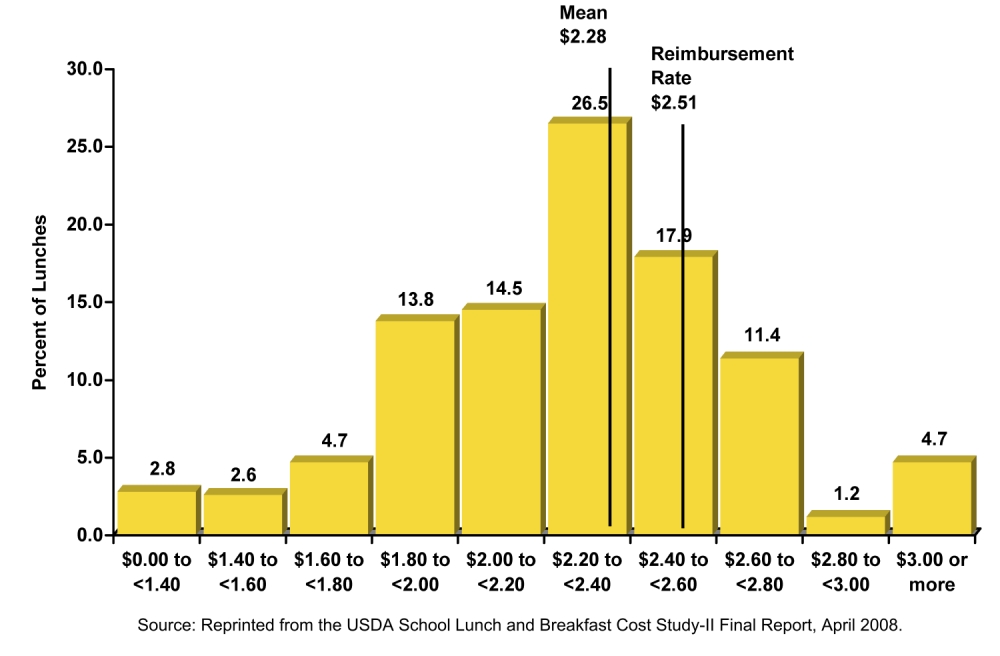
The federal government uses this type of straightforward comparison of costs and revenues to judge whether the federal reimbursement rate for meals served by the National School Lunch Program (NLSP) and School Breakfast Program (SBP) is adequate. The influential periodic federal School Lunch and Breakfast Cost Study, completed most recently in April 2008, estimated that the national mean cost to provide a school lunch was $2.28 in the 2005-06 school year, which was less than the federal reimbursement per free lunch of $2.51 that year (USDA/FNS, 2008). Perhaps there was even a little change left over.

The School Nutrition Association, the trade association for school food service operations, uses a similar straightforward comparison, though, not surprisingly, it reaches a different conclusion. Its September 2008 report, Heat’s On: School Meals Under Financial Pressure, based on a less systematic survey of 45 large school districts, estimated that median costs had risen to $2.92 for the 2008-2009 school year, while the federal reimbursement per free lunch had risen only to $2.78. Especially when one considers the growing public pressure to provide better and more nutritious food, these estimates imply a painful financial shortfall.
Yet, neither of these comparisons of costs and reimbursements can answer the original question. First, there are diverse ideas about what is a “healthy” meal. To qualify for the federal lunch and breakfast programs, meals are expected to provide foods from multiple food groups and to meet general nutrient guidelines. In many local districts, school food programs face rising expectations for quality and nutrition characteristics that exceed federal minimum standards. Second, the economics of school food service are both more complex and more fascinating than these simple comparisons allow.

The School Food Service as a Business

Think of a school food service operation as a business. It is a not-for-profit business, in the sense that there are no dividends for private shareholders or owners. Yet, most school food services are required to break even, so the economic pressures are very similar to those facing any business.
The business has many products to sell. The free federal lunches for low-income children, whose reimbursements were summarized above, are just one fraction of this business. Within the NSLP, the school food operation also serves reduced-price lunches for moderate-income children and “paid” lunches for children from better-off families. The “paid” lunches are still federally subsidized to some extent as long as the meal meets the requirements of the federal lunch program the school food service gets to set its own price for the meal. Meanwhile, the school food service also sells a la carte items, trading off the loss of federal subsidy against the advantages of being able to sell more desirable or profitable products that would not qualify as a reimbursable meal. Then, many school food services offer a federally subsidized School Breakfast Program and a whole array of unsubsidized products through sales to teachers, snack bars, vending machines, and, commonly, a catering business for school events that offer food.
In each of these business lines, the school food service faces a different consumer demand curve (the economist’s tool for explaining how sales will respond to changes in price and other factors), a different menagerie of competitors, and a different library of external rules and non-economic pressures. In some school districts, the vending machine line will be a small monopoly for the school food service director, while in others the school food service director must compete with vending machines set up by coaches or administrators, who use them for additional program revenue. In some districts, the school food service will provide the only lunches for sale at high school, competing only with bagged or boxed lunches from home, while in other districts an open-campus policy will require the school food service to compete with nearby stores and restaurants for lunch sales. Some school districts have strong rules about the nutritional quality of “competitive foods”, a catch-all term for all food and beverage lines that compete with the federal meals programs, while other districts have little regulation beyond a very mild federal requirement about “foods of minimal nutritional value” which prohibits sale of a very limited group of treats, only during meal time, and only in the vicinity of the cafeteria.
Any successful business must understand the economic interactions across its product lines, but these interactions are particularly intense for a school food service. A child who consumes a reimbursable lunch and breakfast will have lower demand for a la carte items, while a child who skips a real meal may be hungrier for a snack. This interaction means that school food service decisions about competitive foods strongly affect the federal school meals program, and vice versa.
The simple cost and reimbursement comparisons at the start of this article essentially suppose economic success depends primarily on having the federal reimbursement exceed an average cost per reimbursable lunch. However, the school food service’s success really depends jointly on the economics of serving free reimbursable meals, partially subsidized reimbursable meals, and the competitive food businesses.
If the subsidized meal program brings in comparatively high net revenue per student, then a school food service director has a strong incentive to maintain sales in the subsidized program, proceeding cautiously with any reforms that threaten the student appeal of the meal. On the other hand, if the competitive foods bring in comparatively high net revenue per student, then, paradoxically, efforts to improve the appeal of the subsidized lunches could harm the bottom line of the school food service as a whole.
The School Lunch and Breakfast Cost Study II gives a preliminary indication of the cross-subsidization patterns on average. In contrast with school lunches, the average federal reimbursement for a school breakfast was insufficient to cover the average cost. Meanwhile, although the reimbursement for “free” lunches exceeded the costs, the average revenue for “paid,” only partly subsidized, lunches was below the cost of producing the meal. More surprisingly, the report found that revenue from a la carte or nonreimbursable sales was insufficient to cover the costs on average.
Moreover, these averages tell only part of the story. Figure 1 shows the best known statistics from the federal School Lunch and Breakfast Cost Study II, including average costs of $2.28 and a federal reimbursement of $2.51 per free lunch. The figure also shows a striking diversity across districts. About 24% of free lunches cost less than $2.00, far below the reimbursement rate, suggesting that the free lunch program in some districts may in effect cross-subsidize other business lines for the school food service. At the other end of the spectrum, about 17% of free lunches cost more than $2.60, suggesting that the free lunch program effectively is subsidized by other sales. Some school food services earn higher profits at the margin by promoting a la carte sales at the expense of reimbursable meals, while others earn more by strongly backing the federal lunch program.

Costs of Improving Meals

If we think of the school food service as a business, we need to understand the costs and revenues for different food and beverage offerings, and to understand how nutrition quality improvements affect both costs and revenues. Surprisingly, there is promising evidence to suggest that more healthful choices can be provided while costs are kept in check. According to the results of the California-based Linking Education, Activity and Food (LEAF) program, increased costs associated with greater fruit and vegetable purchases, packing, and storage were offset, in large part, by increased meal sales and other measures that increased the efficiency of the food service operation (Woodward-Lopez et al., 2005).
An important concern with this approach is that it may require capital investment in the beginning. A case study of the Hopkins School District 270 in Minnesota demonstrates this point nicely (Grainger, Senauer, and Runge, 2007). This school district completely overhauled its school food service program after 2003: they opened a Health Nut Café, which served foods free of trans-fats and high in fiber with low levels of sugars; they removed the soda from the vending machines and replaced it with water and 100% juices; they switched to low-fat salad dressings and cheese, and whole wheat breads and pizza crusts; and they added more vegetables to many dishes. These more nutritious foods were prepared from scratch on-site, making the shift from the previous practice of simply warming the food prior to service. While the Hopkins food service program was able to remain financially viable, it would have been impossible to get up and running without a significant capital expenditure at the beginning. Most schools do not have the tools necessary to prepare healthful foods. They need an initial investment to improve the kitchen equipment so they can shift from simply heating foods to preparing meals from scratch. Additionally, they need money to train school food service workers to prepare more healthful meals. The LEAF program emphasizes this point. The program awarded grants of approximately $200,000 over a 21-month period to 16 middle and high schools in nine California school districts in order to pilot test the implementation of stricter nutritional standards for both meals and competitive foods. The evaluation indicated that capital expenditures for food service equipment was one of the primary uses of these grant funds (Woodward-Lopez et al., 2005).
The need for capital investment was addressed in the American Recovery and Reinvestment Act of 2009 (ARRA), which was signed into law by President Obama on Feb. 17, 2009. The ARRA provides a onetime appropriation of $100 million for equipment purchase assistance to school food authorities (SFAs) participating in the NSLP. As stipulated in the ARRA, priority will be given to SFAs for equipment for schools in which at least 50% of the students are eligible for free or reduced-price meals (USDA, 2009).

Revenue from Improving Meals

In addition to costs, the business must consider how healthier meals might affect revenues. School cafeterias will not be able to stay in business, no matter what the reimbursement rate, if students do not choose to purchase the food offered in the cafeteria. While many believe that students will not be willing to purchase nutritious foods, there is evidence to suggest otherwise.
In 2005, the USDA released a report entitled Making It Happen! School Nutrition Success Stories. This report included case studies of 32 schools and school districts that have made innovative changes to improve the nutritional quality of their food programs. One of the overarching conclusions from the report is that students will buy and consume healthful foods and beverages—and schools can make money from healthful options. Of the 17 schools and districts that reported sales data in the report, 12 made more money and four made the same amount of money after making nutrition improvements (USDA, 2005). That was certainly the case at the Hopkins School District 270 in Minnesota where they noted a steady improvement in the nutritional quality of students’ food choices. An analysis of their sales data revealed that students were clearly making healthier choices in April 2005 than they were in November 2004 (Grainger, Senauer, and Runge, 2007).
This finding comes with one caveat: it appears that there may be a period of decreased revenue while students make the transition to the more healthful offerings. At the Byfield Elementary School in Bristol, R.I., one of the schools highlighted in USDA’s report titled Making It Happen!, income from the new “wholesome snack” a la carte items did decrease $5 to $10 per day during the first year they were introduced; however, second-year sales recovered, and average daily revenue increased slightly above original levels. These new sales levels were maintained through year three (USDA, 2005).

NSLP Improvements Depend on Rules for Competitive Foods

Finally, to understand school food service as a business, one must pay attention to the competitive environment. The adequacy of the reimbursement rate for the National School Lunch Program depends in part on the nature of the NSLP’s competitors. Every day students have the choice of what to buy for lunch. In addition to the menu offered from the NSLP, they have the option to purchase food from a school store or vending machine, to buy one or more a la carte items, or—if they go to school on an open campus—they could choose to go to a nearby food vendor (e.g., fast food establishment) to purchase lunch. Only one of the choices mentioned is likely to provide a nutritious meal. School meals must meet nutrition standards in order for a school food service program to receive federal subsidies. In contrast, foods sold outside the meal programs (i.e., competitive foods), including those sold in vending machines, a la carte lines, school stores, snack bars, and fund raisers, are not required by the USDA to meet comparable nutrition standards (MAHK, 2007).
Policies to limit access to competitive foods may impact the financial viability of school lunch programs, and ultimately affect their ability to offer more healthful selections. Studies have noted that as income from a la carte sales increases, student participation in meal programs decreases (USDA, 2005). The severity of this was illustrated in a 2003 survey of all 1,256 school districts in Texas. The survey, conducted by the state’s Department of Agriculture, found that sales of competitive foods resulted in up to $60 million in lost income from school meals (USDA, 2005). The LEAF program fiscal impact report reinforces this point, finding that the greatest meal revenue increases were seen in sites that completely eliminated a la carte food sales (Woodward-Lopez et al., 2005).
Additionally, open-campus policies seem to pose a significant threat to the financial viability of the NSLP. A 2008 USDA report on the background, trends, and issues of the NSLP cited an open-campus policy as a characteristic that contributed to a school’s difficulty in maintaining net income from their school food service business (USDA, 2008). This evidence suggests that strict rules for competitive foods and access to off-site restaurants during the school day can play an important role in helping school districts meet nutrition quality goals while simultaneously satisfying the economic constraints of the school food service business.

Multiple Routes to a Single Destination

Reviewing school food service as a business offers insight into what policies could facilitate a healthier school environment. This review suggests that there may be multiple strategies to enable school food services to improve their offerings without violating their economic constraints.
First, and most obviously, with a higher reimbursement rate or greater local subsidies, schools could better afford appealing, healthy foods even in those circumstances when they are more expensive. Second, with money for capital investments, it may be possible to improve nutritional quality and taste even at a constant per-meal reimbursement rate. But, these are the easy remedies. Hoping for additional resources is like wishing the harder challenges would just go away.
In the likely case that additional resources are limited because federal and local governments face continued severe budget constraints, school districts may consider measures that protect the federal meals programs from less healthy competition. Through local wellness policies, districts can establish rules about the nutritional quality of competitive foods and a “closed-campus” policy that limits competition from nearby restaurants and convenience stores at lunch time. Because of the interactions across business lines, such policies can improve the economic feasibility of serving healthy meals through the federal programs themselves.
These limitations on competitors may seem like a strange policy prescription. Who ever heard of an agricultural economist tacitly endorsing limitations on consumer choices? Certainly, the nutritional and economic advantages of such policies must be weighed against the real welfare value of allowing children to express their own food preferences at school, as they do outside of school. The Just and Wansink article in this theme warns against unintentionally increasing the appeal of unhealthy products by banning them outright. Nevertheless, placing some reasonable limits on competitive food is not really economic heresy. For centuries, economists have admired markets as a coordinating tool for economic decisions in communities composed of households, but economists have always acknowledged beneficent non-market decision-making within households. Schools are not marketplaces but educational institutions responsible for the welfare of their charges. If schools are expected to respond to the current epidemic of childhood obesity by improving the school food environment, and taxpayers are reluctant simply to provide more resources, then there is some merit in considering measures to enhance the relative competitive position of healthy meals served through the National School Lunch Program and School Breakfast Program.

For More Information

Grainger, C., Senauer, B., and Runge, C.F. (2007). Nutritional improvements and student foods choices in a school lunch program. Journal of Consumer Affairs, 41(2).
Massachusetts Action for Healthy Kids (MAHK). (2007). Massachusetts a la carte food and beverage standards to promote a healthier food environment. Available online: http://www.maclearinghouse.com/PDFs/Health&Wellness/MA_Food_Standards.pdf.
Ralston, K., Newman, C., Clauson, A., Guthrie, J., and Buzby, J. (2008). The National School Lunch Program: Background, Trends, and Issues, ERR-61, U.S. Dept. of Agriculture, Economic Research Service.
U.S. Department of Agriculture. (2009). 2009 Equipment Assistance Grants for School Food Authorities. Available online: http://www.fns.usda.gov/fns/recovery/memos/SP_18-2009_sa.pdf.
U.S. Department of Agriculture, Food and Nutrition Service (USDA/FNS). (2008). School Lunch and Breakfast Cost Study – II, Final Report. April 2008. Available online: http://www.fns.usda.gov/oane/.
U.S. Department of Agriculture, Food and Nutrition Service, United States Department of Health and Human Services, Centers for Disease Control and Prevention, and United States Department of Education. (2005). Making it Happen! School Nutrition Success Stories, January. Available online: http://www.fns.usda.gov/TN/Resources/makingithappen.html.
Woodward-Lopez, G., Vargas, A., Kim, S., Proctor, C., Hiort-Lorenzen, D.-L., and Crawford, P. (2005). LEAF Cross-Site Evaluation: Fiscal Impact Report, Center for Weight and Health, University of California, Berkeley. Available online: http://www.cnr.berkeley.edu/cwh/activities/LEAF.shtml.
Figure 1
Figure 1
Distribution of Lunches by Reported Cost per Reimbursable Lunch.
– See more at: http://www.choicesmagazine.org/magazine/article.php?article=86#sthash.VDCHoB9J.dpuf

How is the National School Lunch Program Working in Indian Country

Child Nutrition Programs, National School Lunch Program
12/9/14
New guidelines for the National School Lunch Program are aimed at providing the nation’s children with healthy, age-appropriate meals in an effort to reduce childhood obesity and improve the overall well-being of kids, especially poor kids, across the country.
A Matter of National Security
The federal government established the school lunch program in the early 1930s to try to prevent widespread childhood malnutrition during the Depression and to support struggling farmers by having the federal government buy up surplus commodity foods. By 1942, 454 million pounds of surplus food was distributed to 93,000 schools for lunch programs that benefited 6 million children.
But when the U.S. joined World War II, the U.S. Armed Forces needed all of the surplus food U.S. farmers were producing. By April 1944, only 34,064 schools were participating in the school lunch program and the number of children being served had dropped to 5 million.
In the spring of 1945, Gen. Lewis B. Hershey, a former school principal, told the House Agriculture Committee that as many as 40 percent of rejected draftees had been turned away owing to poor diets. “Whether we are going to have war or not, I do think that we have got to have health if we are going to survive,” he testified. Within a year, Congress passed legislation to appropriate money to support the program on a year-by-year basis and by April 1946, the program had expanded to include 45,119 schools and 6.7 million children.
In 1946, Congress established a permanent National School Lunch Program (NSLP). In the legislation, adequate child nutrition was explicitly recognized as a national security priority. The program was administered by the states, which were required to match federal dollars. Nutritional standards were set by the federal government, and states were required to provide free and reduced priced lunches to children who could not pay.
Nawayee Center School in Minneapolis serves 55 American Indian high school students. (Nawayee Center School)
Childhood Obesity Epidemic
Fast-forward half a century. By 2009, the Department of Defense reported that more recruits were being rejected for obesity than for any other medical reason. This was around the same time that First Lady Michelle Obama was taking on childhood obesity as a national health crisis.
Childhood obesity, reports the Centers for Disease Control, has more than doubled in children (to 18 percent) and quadrupled in adolescents (to 21 percent) in the past 30 years. In 2012, more than 30 percent of American children and adolescents were overweight or obese. These children are at increased risk for cardiovascular disease, diabetes, bone and joint problems, sleep apnea, and social and psychological problems such as stigmatization and poor self-esteem, according to the CDC. By 2030, 50 percent of Americans are predicted to be obese, according to the Harvard School of Public Health.
In the American Indian community, the rate of obesity is even higher. In 2010, the Indian Health Service reported that 80 percent of American Indian/Alaska Native adults and about 50 percent of AI/AN children were overweight or obese.
Nawayee Center School garden and raised bed. Students built the fence around the garden in the second year. Since then they have built flower boxes, started doing seed saving and added recycling and composting. (Nawayee Center School)
Obese and overweight children have access to too many cheap calories with too little nutritional value, leading to the paradox of malnourished overweight children. Poor nutrition, often in the form of too much sugar and other simple carbohydrates, can lead to diabetes, which is rife in AI/AN communities.
Healthy, Hunger-Free Kids Act
Michelle Obama’s child health initiative included her “Let’s Move!” exercise campaign, the first-ever task force on child obesity and her backing for the Healthy, Hunger-Free Kids Act, which passed Congress with bipartisan support in 2010.
The act set new standards, which went into effect in early 2012, for school lunches. These include reduced calories, reduced sugar and reduced sodium combined with increased fresh fruits and vegetables and whole grains. In some cases, schools’ inability to prepare nutritionally adequate, attractive, kid-friendly meals under the new guidelines has led them to drop out of the NSLP altogether. Despite the fact that as of September 2013, only 524 out of 100,000 schools participating in the NSLP, or one half of one percent had dropped out, news coverage has been extensive, complete with photos of unappetizing meals, accounts of student protests and a good deal of criticism of Michelle Obama, who as the point person for the healthy school lunch initiative, is an obvious target.
Nawayee Center School students working in the garden. (Nawayee Center School)
Poor Children Need School Lunches
But the schools dropping out of the program are mostly schools with few students who qualify for free and reduced-price school lunches. The federal government mandates that schools participating in the NSLP provide free lunches for children from families whose incomes are 130 percent of the poverty level or less. That is, if the poverty level for a family of four is $24,000 per year, then children from families of four whose income is under about $31,200 per year are eligible for free lunches. Reduced-price lunches must be provided for children from families with incomes between 130 percent and 185 percent of the poverty level. So if the poverty level is $24,000 for a family of four, children from families of four earning between $31,200 and $44,400 are eligible for reduced priced lunches. Reduced price lunches may cost no more than $0.40.
According to the National Center for Education Statistics, 68 percent of AI/AN students are eligible for free and reduced-price school lunches, compared with only 28 percent of white students. USDA data indicate that 70 percent of children receiving free lunches through the NSLP are children of color, as are 50 percent of students receiving reduced-price lunches.
The very public criticism of the new guidelines poses a threat to AI/AN and other children of color, as well as poor children in general. If the loudest voices cause the federal government to back down on the nutrition standards, the children who will be most affected are those who rely on school breakfasts, lunches, snacks and summer food programs for a significant portion of their nutrition—that is, poor children, the ones receiving free and reduced-price lunches, as do more than two-thirds of AI/AN children in public and non-profit private schools.
Students at the Nawayee Center School designed and built the garden, and they do all of the planting, weeding, watering and harvesting. The lush garden supplies food for the school lunch program. Students have learned to preserve fruits and vegetables for the winter. (Nawayee Center School)
Successful School Lunch Programs in Indian Country
Not everyone is having trouble meeting the new guidelines.
Joe Rice (Choctaw), executive director of the Nawayee Center School in Minneapolis, says his school started serving healthier meals to its 55 American Indian high schoolers long before the new guidelines went into effect. “We’re sponsored by the Minnesota Department of Education so we have a licensed food and nutrition service that allows us instead of buying food from the local district to buy through a caterer who serves healthier food in line with our diabetes initiative. The fresh food from our garden and the healthier food from the caterer mean that we’re addressing one of the two modifiable risk factors for diabetes, which is diet. We’re getting away from sugar and saturated fat and more into healthy whole foods.”
And that’s having an impact. The school screens the kids every year and those who have been with the program for a while “typically have better blood glucose levels, and they report exercising and eating more healthy foods throughout the week. We also see healthier BMIs for the kids who have been in the program longer. Overall, we get good health results.”
The garden is a kid-centered endeavor. The students designed and built the garden and decide what crops to grow. The garden, says Rice, is “reconnecting kids to the earth. I remember the first time we had some stuff from the garden, the kids refused to eat it because it came out of the ground.” It also serves as a means of teaching biology, botany, math and language. “We found that gardening could be the starting point for a very rich curriculum and for cultural preservation and revitalization.”
The STAR School just outside Flagstaff, Arizona, serves about 120 Navajo students in grades pre-K through 8. There, too, gardening is a key component of the nutrition program, although until the school can get its gardens and food safety practices certified by the government, garden produce is used only for cooking classes and community events.
Seventh and eighth graders at the STAR School shucking Navajo white corn in the early fall of 2014. The corn was then shaved and stored in the freezer to be used later. (STAR School)
Louva Montour (Diné) is food services manager. She says the school has had no trouble meeting the new guidelines. STAR School has its own garden and greenhouses, and students also work on a Navajo farm about 20 miles from the school, where they help with planting, watering, weeding and harvesting. “It really helps that they get hands-on experience working with food, from planting, even preparing the soil, composting (Our kids know a lot about composting!), the whole cycle,” says Montour.
Montour gives an example of the value of having kids grow the food they are going to eat: “We’re on our third year now using our salad bar. When we started putting out different types of vegetables, like beets, the students didn’t really know what beets were and they weren’t really trying it. But then they grew some in our greenhouse. Once they harvested them—those things are really big, about half a pound!—kids were saying ‘What is it?’ and ‘I want to eat it.’ They cleaned it and then we just cut it up right there because they wanted to eat it right there. And we let them because that’s the time for them to try it, when they’re willing.”
Beets have become a salad bar favorite, she says, as have other unlikely vegetables such as kale. Even though the school cannot yet use produce from its own gardens or those of local Navajo farmers, they are able to get local and organic produce through their regular food distributor who works with local producers.
Special Circumstances in Indian Country
Dianne Amiotte-Seidel, Oglala Sioux, project director/marketing coordinator for an ANA grant awarded to the InterTribal Buffalo Council in South Dakota, which is a coalition of 56 tribes committed to reestablishing buffalo herds on Indian lands in a manner that promotes cultural enhancement, spiritual revitalization, ecological restoration, and economic development.
Amiotte-Seidel has already more than met the grant’s requirement that she introduce bison meat, which is much healthier for kids than beef, into eight school lunch programs, but it hasn’t been easy. “You can’t just put buffalo meat in the schools. You have a lot of different steps to take and each state is different,” she says.
A child at Taos Pueblo school finished her buffalo entree first! This is one of the schools included in the ANA grant awarded to the InterTribal Buffalo Council. (Dianne Amiotte-Seidel)
In order for a school to serve bison, “a tribe has to have enough buffalo to supply the school for one meal a week or a month, or whatever, and then they have to have a USDA plant nearby. They have to be willing to sell the buffalo meat to the school for the price of beef and they have to be able to have a supplier from a USDA plant take the meat to the school. The meat needs to bear a child nutrition label. The school has to be able to have a supply area big enough store the bison meat they need for the year, since tribes usually only do their harvest once a year.”
Amiotte-Seidel adds, “The biggest obstacle is the requirement to have USDA-certified slaughtering plants, because on the reservations that I’m dealing with, let’s use Lower Brule, for example. Lower Brule is four or five hours away from a certified USDA plant. They have to haul buffalo four to five hours to have USDA certify the meat for the school.”
This is one area where perhaps guidelines should be modified to better fit the unique circumstances in Indian Country and other areas where they present a burden so severe that the NSLP fails to meet its original goal—feeding poor children—as well as it could.