Wordware Inc, is the old and best player in the school Lunch software field. Wordware is working on the may flower since 1986, they have vast experience in the field. Wordware has best team deployed and continuously working for improvement of Mayflower lcs1000. This software is audit proof, many audit has been already passed. you need not to worry for anything. Once you install this in your school cafeteria you accounting process becomes smooth and you staff, students and parents will feel happy.
After just one year, some schools around the country are
dropping out of the healthier new federal lunch program, complaining
that so many students turned up their noses at meals packed with whole
grains, fruits and vegetables that the cafeterias were losing money.
Federal officials say they don’t have exact numbers but have seen
isolated reports of schools cutting ties with the $11 billion National
School Lunch Program, which reimburses schools for meals served and
gives them access to lower-priced food.
Districts that rejected the program say the reimbursement was not
enough to offset losses from students who began avoiding the lunch line
and bringing food from home or, in some cases, going hungry.
PlayVideo
The Lunch Express brings meals to kids in need in rural Tenn.
“Some of the stuff we had to offer, they wouldn’t eat,” said Catlin,
Ill., Superintendent Gary Lewis, whose district saw a 10 to 12 percent
drop in lunch sales, translating to $30,000 lost under the program last
year.
“So you sit there and watch the kids, and you know they’re hungry at
the end of the day, and that led to some behavior and some lack of
attentiveness.”
In upstate New York, a few districts have quit the program, including
the Schenectady-area Burnt Hills Ballston Lake system, whose five
lunchrooms ended the year $100,000 in the red.
Near Albany, Voorheesville Superintendent Teresa Thayer Snyder said
her district lost $30,000 in the first three months. The program didn’t
even make it through the school year after students repeatedly
complained about the small portions and apples and pears went from the
tray to the trash untouched.
Districts that leave the program are free to develop their own
guidelines. Voorheesville’s chef began serving such dishes as salad
topped with flank steak and crumbled cheese, pasta with chicken and
mushrooms, and a panini with chicken, red peppers and cheese.
In Catlin, soups and fish sticks will return to the menu this year,
and the hamburger lunch will come with yogurt and a banana – not one or
the other, like last year.
Nationally, about 31 million students participated in the guidelines thattook effect last fall under the 2010 Healthy, Hunger-Free Kids Act.
Dr. Janey Thornton, deputy undersecretary for USDA’s Food, Nutrition
and Consumer Services, which oversees the program, said she is aware of
reports of districts quitting but is still optimistic about the
program’s long-term prospects.
“Many of these children have never seen or tasted some of the fruits
and vegetables that are being served before, and it takes a while to
adapt and learn,” she said.
The agency had not determined how many districts have dropped out,
Thornton said, cautioning that “the numbers that have threatened to drop
and the ones that actually have dropped are quite different.”
The School Nutrition Association found that 1 percent of 521 district
nutrition directors surveyed over the summer planned to drop out of the
program in the 2013-14 school year and about 3 percent were considering
the move.
Not every district can afford to quit. The National School Lunch
Program provides cash reimbursements for each meal served: about $2.50
to $3 for free and reduced-priced meals and about 30 cents for
full-price meals. That takes the option of quitting off the table for
schools with large numbers of poor youngsters.
PlayVideo
USDA, First Lady makeover school lunches
The new guidelines set limits on calories and salt, phase in more
whole grains and require that fruit and vegetables be served daily. A
typical elementary school meal under the program consisted of
whole-wheat cheese pizza, baked sweet potato fries, grape tomatoes with
low-fat ranch dip, applesauce and 1 percent milk.
In December, the Agriculture Department, responding to complaints
that kids weren’t getting enough to eat, relaxed the 2-ounce-per-day
limit on grains and meats while keeping the calorie limits.
At Wallace County High in Sharon Springs, Kan., football player
Callahan Grund said the revision helped, but he and his friends still
weren’t thrilled by the calorie limits (750-850 for high school) when
they had hours of calorie-burning practice after school. The idea of
dropping the program has come up at board meetings, but the district is
sticking with it for now.
“A lot of kids were resorting to going over to the convenience store
across the block from school and kids were buying junk food,” the
17-year-old said. “It was kind of ironic that we’re downsizing the
amount of food to cut down on obesity but kids are going and getting
junk food to fill that hunger.”
To make the point, Grund and his schoolmates starred last year in a music video parodyof the pop hit “We Are Young.” Instead, they sang, “We Are Hungry.”
It was funny, but Grund’s mother, Chrysanne Grund, said her anxiety was not.
“I was quite literally panicked about how we would get enough food in
these kids during the day,” she said, “so we resorted to packing
lunches most days.”
When he signed the National School Lunch Act 69 years ago this month, President Harry Truman said
that the law would go a long way toward “strengthening the nation
through better nutrition for our school children.” As schools across the
nation continue to implement the updated nutrition standards that took
effect in 2012, a statewide poll from the Kids’ Safe and Healthful Foods
Project finds that 82 percent of Minnesota voters overall and 76
percent of those with children in public school support those standards. Pollster Memo (PDF) | Full Results (PDF)
Support for Nutritious Food in School Is Overwhelming
We asked: Do you think that serving nutritious foods in schools is very
important, somewhat important, not that important, or not important at
all in helping to ensure that children are prepared to learn and do
their best in school?
Total Important (%)
Registered voters
97
Parents of K-12 public school students
96
Source: Minnesota School Nutrition Survey, February 2015
Specific parts of the updated nutrition standards garnered as much or
even higher levels of support from Minnesota voters than the standards
broadly. Nearly all voters and public school parents say school lunches
should include a serving of fruits or vegetables, and more than 7 in 10
believe schools should provide whole-grain foods with every meal and
should limit the amount of salt.
Key Nutritional Improvements Receive Strong Support
We asked: Do you think public schools should be required to do the following with every school meal? And do you feel strongly about that? Include a serving of fruits or vegetables
% Yes
(Strongly)
Registered voters
96
(90)
Parents of K-12 public school students
94
(86)
Provide foods made from whole grains
% Yes
(Strongly)
Registered voters
74
(52)
Parents of K-12 public school students
73
(48)
Limit the amount of salt
% Yes
(Strongly)
Registered voters
79
(55)
Parents of K-12 public school students
72
(46)
Source: Minnesota School Nutrition Survey, February 2015
Nutrition standards for meals served under the National School Lunch
Program have been updated regularly since the program’s inception in
1946. Since the start of the 2012-13 school year, lunches and breakfasts
have included more lean protein, low-fat dairy products, and fruits and
vegetables, while avoiding excess fat, salt, and calories. As of
December 2014, the vast majority of Minnesota schools (98.8 percent) are
certified as meeting these healthier standards.
Support for updated nutrition standards for school meals was seen
across the ideological spectrum, with 75 percent of Republicans, 76
percent of independents, and 91 percent of Democrats in favor.
Seventy-five percent of voters and 69 percent of parents also support
the USDA’s new “Smart Snacks in School” rule, which took effect in the
2014-15 school year and sets basic limits on fat, salt, sugar, and
calories in food and drinks sold in vending machines, at snack bars, and
on a la carte cafeteria menus.
Our survey also asked whether certain changes beyond those needed to
meet national standards would further improve school meals. More than 7
in 10 voters and public school parents think meals would be better if
prepared in the cafeteria’s kitchen instead of being prepackaged and
reheated. And 70 percent of voters and 65 percent of public school
parents believe that offering a variety of fruits, vegetables, and whole
grains improves school menus. Although many schools have made such
adjustments to their menus and cooking approaches, others are hampered
by outdated or limited kitchen facilities. In a survey of school food
service directors, 96 percent of Minnesota districts reported needing at least one piece of equipment—at a median cost of $47,000 per school—to better serve nutritious foods.
More about the poll
The Minnesota statewide poll was conducted by Public Opinion
Strategies and Hart Research Associates for the Kids’ Safe and Healthful
Foods Project, a collaboration between The Pew Charitable Trusts and
the Robert Wood Johnson Foundation. Data were collected via landline and
cellular telephone surveys Feb. 17-19, 2015, among 500 registered
voters, including 200 parents or guardians of children in K-12 public or
charter schools. The margin of error on the sample of 500 is plus or
minus 4.4 percentage points, and the margin of error on the sample of
200 is plus or minus 6.9 percentage points.
The poll is the latest in a series of state surveys
conducted for the project. Each has revealed overwhelming support for
the nutrition standards that are in place for school lunches and
breakfasts as well as the snack food and drinks sold separately.
Similarly, a June 2014 poll showed strong support for these policies among K-12 parents nationwide.
At first, the question seems simple: “Is it economically feasible to serve healthy food in school?”
And, at first, the road to an answer seems equally simple: one must
estimate the cost of serving a meal and then confirm that revenue
suffices to cover this cost.
The federal government uses this type of straightforward comparison
of costs and revenues to judge whether the federal reimbursement rate
for meals served by the National School Lunch Program (NLSP) and School
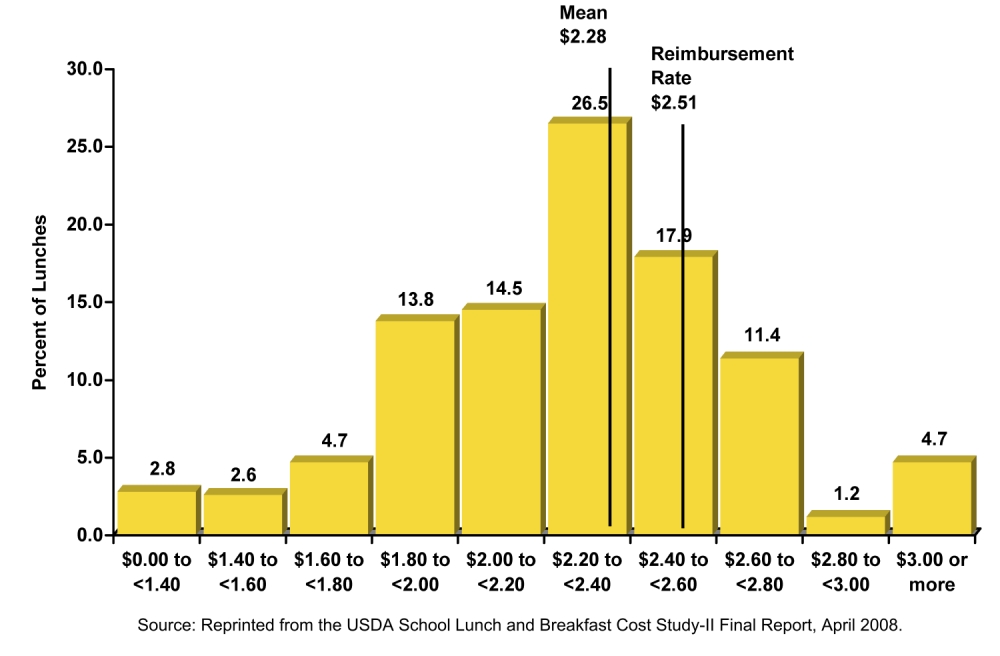
Breakfast Program (SBP) is adequate. The influential periodic federal School Lunch and Breakfast Cost Study,
completed most recently in April 2008, estimated that the national mean
cost to provide a school lunch was $2.28 in the 2005-06 school year,
which was less than the federal reimbursement per free lunch of $2.51
that year (USDA/FNS, 2008). Perhaps there was even a little change left
over.
The School Nutrition Association, the trade association for school
food service operations, uses a similar straightforward comparison,
though, not surprisingly, it reaches a different conclusion. Its
September 2008 report, Heat’s On: School Meals Under Financial Pressure,
based on a less systematic survey of 45 large school districts,
estimated that median costs had risen to $2.92 for the 2008-2009 school
year, while the federal reimbursement per free lunch had risen only to
$2.78. Especially when one considers the growing public pressure to
provide better and more nutritious food, these estimates imply a painful
financial shortfall.
Yet, neither of these comparisons of costs and reimbursements can
answer the original question. First, there are diverse ideas about what
is a “healthy” meal. To qualify for the federal lunch and breakfast
programs, meals are expected to provide foods from multiple food groups
and to meet general nutrient guidelines. In many local districts, school
food programs face rising expectations for quality and nutrition
characteristics that exceed federal minimum standards. Second, the
economics of school food service are both more complex and more
fascinating than these simple comparisons allow.
The School Food Service as a Business
Think of a school food service operation as a business. It is a
not-for-profit business, in the sense that there are no dividends for
private shareholders or owners. Yet, most school food services are
required to break even, so the economic pressures are very similar to
those facing any business.
The business has many products to sell. The free federal lunches for
low-income children, whose reimbursements were summarized above, are
just one fraction of this business. Within the NSLP, the school food
operation also serves reduced-price lunches for moderate-income children
and “paid” lunches for children from better-off families. The “paid”
lunches are still federally subsidized to some extent as long as the
meal meets the requirements of the federal lunch program the school food
service gets to set its own price for the meal. Meanwhile, the school
food service also sells a la carte items, trading off the loss of
federal subsidy against the advantages of being able to sell more
desirable or profitable products that would not qualify as a
reimbursable meal. Then, many school food services offer a federally
subsidized School Breakfast Program and a whole array of unsubsidized
products through sales to teachers, snack bars, vending machines, and,
commonly, a catering business for school events that offer food.
In each of these business lines, the school food service faces a
different consumer demand curve (the economist’s tool for explaining how
sales will respond to changes in price and other factors), a different
menagerie of competitors, and a different library of external rules and
non-economic pressures. In some school districts, the vending machine
line will be a small monopoly for the school food service director,
while in others the school food service director must compete with
vending machines set up by coaches or administrators, who use them for
additional program revenue. In some districts, the school food service
will provide the only lunches for sale at high school, competing only
with bagged or boxed lunches from home, while in other districts an
open-campus policy will require the school food service to compete with
nearby stores and restaurants for lunch sales. Some school districts
have strong rules about the nutritional quality of “competitive foods”, a
catch-all term for all food and beverage lines that compete with the
federal meals programs, while other districts have little regulation
beyond a very mild federal requirement about “foods of minimal
nutritional value” which prohibits sale of a very limited group of
treats, only during meal time, and only in the vicinity of the
cafeteria.
Any successful business must understand the economic interactions
across its product lines, but these interactions are particularly
intense for a school food service. A child who consumes a reimbursable
lunch and breakfast will have lower demand for a la carte items,
while a child who skips a real meal may be hungrier for a snack. This
interaction means that school food service decisions about competitive
foods strongly affect the federal school meals program, and vice versa.
The simple cost and reimbursement comparisons at the start of this
article essentially suppose economic success depends primarily on having
the federal reimbursement exceed an average cost per reimbursable
lunch. However, the school food service’s success really depends jointly
on the economics of serving free reimbursable meals, partially
subsidized reimbursable meals, and the competitive food businesses.
If the subsidized meal program brings in comparatively high net
revenue per student, then a school food service director has a strong
incentive to maintain sales in the subsidized program, proceeding
cautiously with any reforms that threaten the student appeal of the
meal. On the other hand, if the competitive foods bring in comparatively
high net revenue per student, then, paradoxically, efforts to improve
the appeal of the subsidized lunches could harm the bottom line of the
school food service as a whole.
The School Lunch and Breakfast Cost Study II gives a
preliminary indication of the cross-subsidization patterns on average.
In contrast with school lunches, the average federal reimbursement for a
school breakfast was insufficient to cover the average cost. Meanwhile,
although the reimbursement for “free” lunches exceeded the costs, the
average revenue for “paid,” only partly subsidized, lunches was below
the cost of producing the meal. More surprisingly, the report found that
revenue from a la carte or nonreimbursable sales was insufficient to cover the costs on average.
Moreover, these averages tell only part of the story. Figure 1 shows the best known statistics from the federal School Lunch and Breakfast Cost Study II,
including average costs of $2.28 and a federal reimbursement of $2.51
per free lunch. The figure also shows a striking diversity across
districts. About 24% of free lunches cost less than $2.00, far below the
reimbursement rate, suggesting that the free lunch program in some
districts may in effect cross-subsidize other business lines for the
school food service. At the other end of the spectrum, about 17% of free
lunches cost more than $2.60, suggesting that the free lunch program
effectively is subsidized by other sales. Some school food services earn
higher profits at the margin by promoting a la carte sales at the expense of reimbursable meals, while others earn more by strongly backing the federal lunch program.
Costs of Improving Meals
If we think of the school food service as a business, we need to
understand the costs and revenues for different food and beverage
offerings, and to understand how nutrition quality improvements affect
both costs and revenues. Surprisingly, there is promising evidence to
suggest that more healthful choices can be provided while costs are kept
in check. According to the results of the California-based Linking
Education, Activity and Food (LEAF) program, increased costs associated
with greater fruit and vegetable purchases, packing, and storage were
offset, in large part, by increased meal sales and other measures that
increased the efficiency of the food service operation (Woodward-Lopez
et al., 2005).
An important concern with this approach is that it may require
capital investment in the beginning. A case study of the Hopkins School
District 270 in Minnesota demonstrates this point nicely (Grainger,
Senauer, and Runge, 2007). This school district completely overhauled
its school food service program after 2003: they opened a Health Nut
Café, which served foods free of trans-fats and high in fiber with low
levels of sugars; they removed the soda from the vending machines and
replaced it with water and 100% juices; they switched to low-fat salad
dressings and cheese, and whole wheat breads and pizza crusts; and they
added more vegetables to many dishes. These more nutritious foods were
prepared from scratch on-site, making the shift from the previous
practice of simply warming the food prior to service. While the Hopkins
food service program was able to remain financially viable, it would
have been impossible to get up and running without a significant capital
expenditure at the beginning. Most schools do not have the tools
necessary to prepare healthful foods. They need an initial investment to
improve the kitchen equipment so they can shift from simply heating
foods to preparing meals from scratch. Additionally, they need money to
train school food service workers to prepare more healthful meals. The
LEAF program emphasizes this point. The program awarded grants of
approximately $200,000 over a 21-month period to 16 middle and high
schools in nine California school districts in order to pilot test the
implementation of stricter nutritional standards for both meals and
competitive foods. The evaluation indicated that capital expenditures
for food service equipment was one of the primary uses of these grant
funds (Woodward-Lopez et al., 2005).
The need for capital investment was addressed in the American
Recovery and Reinvestment Act of 2009 (ARRA), which was signed into law
by President Obama on Feb. 17, 2009. The ARRA provides a onetime
appropriation of $100 million for equipment purchase assistance to
school food authorities (SFAs) participating in the NSLP. As stipulated
in the ARRA, priority will be given to SFAs for equipment for schools in
which at least 50% of the students are eligible for free or
reduced-price meals (USDA, 2009).
Revenue from Improving Meals
In addition to costs, the business must consider how healthier meals
might affect revenues. School cafeterias will not be able to stay in
business, no matter what the reimbursement rate, if students do not
choose to purchase the food offered in the cafeteria. While many believe
that students will not be willing to purchase nutritious foods, there
is evidence to suggest otherwise.
In 2005, the USDA released a report entitled Making It Happen!School Nutrition Success Stories. This
report included case studies of 32 schools and school districts that
have made innovative changes to improve the nutritional quality of their
food programs. One of the overarching conclusions from the report is
that students will buy and consume healthful foods and beverages—and
schools can make money from healthful options. Of the 17 schools and
districts that reported sales data in the report, 12 made more money and
four made the same amount of money after making nutrition improvements
(USDA, 2005). That was certainly the case at the Hopkins School District
270 in Minnesota where they noted a steady improvement in the
nutritional quality of students’ food choices. An analysis of their
sales data revealed that students were clearly making healthier choices
in April 2005 than they were in November 2004 (Grainger, Senauer, and
Runge, 2007).
This finding comes with one caveat: it appears that there may be a
period of decreased revenue while students make the transition to the
more healthful offerings. At the Byfield Elementary School in Bristol,
R.I., one of the schools highlighted in USDA’s report titled Making It Happen!, income from the new “wholesome snack” a la carte
items did decrease $5 to $10 per day during the first year they were
introduced; however, second-year sales recovered, and average daily
revenue increased slightly above original levels. These new sales levels
were maintained through year three (USDA, 2005).
NSLP Improvements Depend on Rules for Competitive Foods
Finally, to understand school food service as a business, one must
pay attention to the competitive environment. The adequacy of the
reimbursement rate for the National School Lunch Program depends in part
on the nature of the NSLP’s competitors. Every day students have the
choice of what to buy for lunch. In addition to the menu offered from
the NSLP, they have the option to purchase food from a school store or
vending machine, to buy one or more a la carte items, or—if they
go to school on an open campus—they could choose to go to a nearby food
vendor (e.g., fast food establishment) to purchase lunch. Only one of
the choices mentioned is likely to provide a nutritious meal. School
meals must meet nutrition standards in order for a school food service
program to receive federal subsidies. In contrast, foods sold outside
the meal programs (i.e., competitive foods), including those sold in
vending machines, a la carte lines, school stores, snack bars,
and fund raisers, are not required by the USDA to meet comparable
nutrition standards (MAHK, 2007).
Policies to limit access to competitive foods may impact the
financial viability of school lunch programs, and ultimately affect
their ability to offer more healthful selections. Studies have noted
that as income from a la carte sales increases, student
participation in meal programs decreases (USDA, 2005). The severity of
this was illustrated in a 2003 survey of all 1,256 school districts in
Texas. The survey, conducted by the state’s Department of Agriculture,
found that sales of competitive foods resulted in up to $60 million in
lost income from school meals (USDA, 2005). The LEAF program fiscal
impact report reinforces this point, finding that the greatest meal
revenue increases were seen in sites that completely eliminated a la carte food sales (Woodward-Lopez et al., 2005).
Additionally, open-campus policies seem to pose a significant threat
to the financial viability of the NSLP. A 2008 USDA report on the
background, trends, and issues of the NSLP cited an open-campus policy
as a characteristic that contributed to a school’s difficulty in
maintaining net income from their school food service business (USDA,
2008). This evidence suggests that strict rules for competitive foods
and access to off-site restaurants during the school day can play an
important role in helping school districts meet nutrition quality goals
while simultaneously satisfying the economic constraints of the school
food service business.
Multiple Routes to a Single Destination
Reviewing school food service as a business offers insight into what
policies could facilitate a healthier school environment. This review
suggests that there may be multiple strategies to enable school food
services to improve their offerings without violating their economic
constraints.
First, and most obviously, with a higher reimbursement rate or
greater local subsidies, schools could better afford appealing, healthy
foods even in those circumstances when they are more expensive. Second,
with money for capital investments, it may be possible to improve
nutritional quality and taste even at a constant per-meal reimbursement
rate. But, these are the easy remedies. Hoping for additional resources
is like wishing the harder challenges would just go away.
In the likely case that additional resources are limited because
federal and local governments face continued severe budget constraints,
school districts may consider measures that protect the federal meals
programs from less healthy competition. Through local wellness policies,
districts can establish rules about the nutritional quality of
competitive foods and a “closed-campus” policy that limits competition
from nearby restaurants and convenience stores at lunch time. Because of
the interactions across business lines, such policies can improve the
economic feasibility of serving healthy meals through the federal
programs themselves.
These limitations on competitors may seem like a strange policy
prescription. Who ever heard of an agricultural economist tacitly
endorsing limitations on consumer choices? Certainly, the nutritional
and economic advantages of such policies must be weighed against the
real welfare value of allowing children to express their own food
preferences at school, as they do outside of school. The Just and
Wansink article in this theme warns against unintentionally increasing
the appeal of unhealthy products by banning them outright. Nevertheless,
placing some reasonable limits on competitive food is not really
economic heresy. For centuries, economists have admired markets as a
coordinating tool for economic decisions in communities composed of
households, but economists have always acknowledged beneficent
non-market decision-making within households. Schools are not
marketplaces but educational institutions responsible for the welfare of
their charges. If schools are expected to respond to the current
epidemic of childhood obesity by improving the school food environment,
and taxpayers are reluctant simply to provide more resources, then there
is some merit in considering measures to enhance the relative
competitive position of healthy meals served through the National School
Lunch Program and School Breakfast Program.
For More Information
Grainger, C., Senauer, B., and Runge, C.F.
(2007). Nutritional improvements and student foods choices in a school
lunch program. Journal of Consumer Affairs, 41(2).
Ralston, K., Newman, C., Clauson, A., Guthrie, J., and Buzby, J. (2008). The National School Lunch Program: Background, Trends, and Issues, ERR-61, U.S. Dept. of Agriculture, Economic Research Service.
U.S. Department of Agriculture, Food and Nutrition Service (USDA/FNS). (2008). School Lunch and Breakfast Cost Study – II, Final Report. April 2008. Available online: http://www.fns.usda.gov/oane/.
U.S. Department of Agriculture, Food and
Nutrition Service, United States Department of Health and Human
Services, Centers for Disease Control and Prevention, and United States
Department of Education. (2005). Making it Happen! School Nutrition Success Stories, January. Available online: http://www.fns.usda.gov/TN/Resources/makingithappen.html.
Woodward-Lopez, G., Vargas, A., Kim, S., Proctor, C., Hiort-Lorenzen, D.-L., and Crawford, P. (2005). LEAF Cross-Site Evaluation: Fiscal Impact Report, Center for Weight and Health, University of California, Berkeley. Available online: http://www.cnr.berkeley.edu/cwh/activities/LEAF.shtml.
Figure 1
Distribution of Lunches by Reported Cost per Reimbursable Lunch.
– See more at: http://www.choicesmagazine.org/magazine/article.php?article=86#sthash.VDCHoB9J.dpuf
New guidelines for the National School Lunch Program are aimed at
providing the nation’s children with healthy, age-appropriate meals in
an effort to reduce childhood obesity and improve the overall well-being
of kids, especially poor kids, across the country. A Matter of National Security
The federal government established the school lunch program in the
early 1930s to try to prevent widespread childhood malnutrition during
the Depression and to support struggling farmers by having the federal
government buy up surplus commodity foods. By 1942, 454 million pounds
of surplus food was distributed to 93,000 schools for lunch programs
that benefited 6 million children.
But when the U.S. joined World War II, the U.S. Armed Forces needed
all of the surplus food U.S. farmers were producing. By April 1944, only
34,064 schools were participating in the school lunch program and the
number of children being served had dropped to 5 million.
In the spring of 1945, Gen. Lewis B. Hershey, a former school
principal, told the House Agriculture Committee that as many as 40
percent of rejected draftees had been turned away owing to poor diets.
“Whether we are going to have war or not, I do think that we have got to
have health if we are going to survive,” he testified. Within a year,
Congress passed legislation to appropriate money to support the program
on a year-by-year basis and by April 1946, the program had expanded to
include 45,119 schools and 6.7 million children.
In 1946, Congress established a permanent National School Lunch
Program (NSLP). In the legislation, adequate child nutrition was
explicitly recognized as a national security priority. The program was
administered by the states, which were required to match federal
dollars. Nutritional standards were set by the federal government, and
states were required to provide free and reduced priced lunches to
children who could not pay.
Nawayee Center School in Minneapolis serves 55 American Indian high school students. (Nawayee Center School)
Childhood Obesity Epidemic
Fast-forward half a century. By 2009, the Department of Defense
reported that more recruits were being rejected for obesity than for any
other medical reason. This was around the same time that First Lady
Michelle Obama was taking on childhood obesity as a national health
crisis.
Childhood obesity, reports the Centers for Disease Control,
has more than doubled in children (to 18 percent) and quadrupled in
adolescents (to 21 percent) in the past 30 years. In 2012, more than 30
percent of American children and adolescents were overweight or obese.
These children are at increased risk for cardiovascular disease,
diabetes, bone and joint problems, sleep apnea, and social and
psychological problems such as stigmatization and poor self-esteem,
according to the CDC. By 2030, 50 percent of Americans are predicted to
be obese, according to the Harvard School of Public Health.
In the American Indian community, the rate of obesity is even higher. In 2010, the Indian Health Service
reported that 80 percent of American Indian/Alaska Native adults and
about 50 percent of AI/AN children were overweight or obese.
Nawayee Center School garden
and raised bed. Students built the fence around the garden in the second
year. Since then they have built flower boxes, started doing seed
saving and added recycling and composting. (Nawayee Center School)
Obese and overweight children have access to too many cheap calories
with too little nutritional value, leading to the paradox of
malnourished overweight children. Poor nutrition, often in the form of
too much sugar and other simple carbohydrates, can lead to diabetes,
which is rife in AI/AN communities. Healthy, Hunger-Free Kids Act
Michelle Obama’s child health initiative included her “Let’s Move!” exercise campaign, the first-ever task force on child obesity and her backing for the Healthy, Hunger-Free Kids Act, which passed Congress with bipartisan support in 2010.
The act set new standards, which went into effect in early 2012, for
school lunches. These include reduced calories, reduced sugar and
reduced sodium combined with increased fresh fruits and vegetables and
whole grains. In some cases, schools’ inability to prepare nutritionally
adequate, attractive, kid-friendly meals under the new guidelines has
led them to drop out of the NSLP altogether. Despite the fact that as of
September 2013, only 524 out of 100,000 schools participating in the
NSLP, or one half of one percent had dropped out, news coverage has been
extensive, complete with photos of unappetizing meals, accounts of
student protests and a good deal of criticism of Michelle Obama, who as
the point person for the healthy school lunch initiative, is an obvious
target.
Nawayee Center School students working in the garden. (Nawayee Center School)
Poor Children Need School Lunches
But the schools dropping out of the program are mostly schools with
few students who qualify for free and reduced-price school lunches. The
federal government mandates that schools participating in the NSLP
provide free lunches for children from families whose incomes are 130
percent of the poverty level or less. That is, if the poverty level for a
family of four is $24,000 per year, then children from families of four
whose income is under about $31,200 per year are eligible for free
lunches. Reduced-price lunches must be provided for children from
families with incomes between 130 percent and 185 percent of the poverty
level. So if the poverty level is $24,000 for a family of four,
children from families of four earning between $31,200 and $44,400 are
eligible for reduced priced lunches. Reduced price lunches may cost no
more than $0.40.
According to the National Center for Education Statistics,
68 percent of AI/AN students are eligible for free and reduced-price
school lunches, compared with only 28 percent of white students. USDA data
indicate that 70 percent of children receiving free lunches through the
NSLP are children of color, as are 50 percent of students receiving
reduced-price lunches.
The very public criticism of the new guidelines poses a threat to
AI/AN and other children of color, as well as poor children in general.
If the loudest voices cause the federal government to back down on the
nutrition standards, the children who will be most affected are those
who rely on school breakfasts, lunches, snacks and summer food programs
for a significant portion of their nutrition—that is, poor children, the
ones receiving free and reduced-price lunches, as do more than
two-thirds of AI/AN children in public and non-profit private schools.
Students at the Nawayee
Center School designed and built the garden, and they do all of the
planting, weeding, watering and harvesting. The lush garden supplies
food for the school lunch program. Students have learned to preserve
fruits and vegetables for the winter. (Nawayee Center School)
Successful School Lunch Programs in Indian Country
Not everyone is having trouble meeting the new guidelines.
Joe Rice (Choctaw), executive director of the Nawayee Center School
in Minneapolis, says his school started serving healthier meals to its
55 American Indian high schoolers long before the new guidelines went
into effect. “We’re sponsored by the Minnesota Department of Education
so we have a licensed food and nutrition service that allows us instead
of buying food from the local district to buy through a caterer who
serves healthier food in line with our diabetes initiative. The fresh
food from our garden and the healthier food from the caterer mean that
we’re addressing one of the two modifiable risk factors for diabetes,
which is diet. We’re getting away from sugar and saturated fat and more
into healthy whole foods.”
And that’s having an impact. The school screens the kids every year
and those who have been with the program for a while “typically have
better blood glucose levels, and they report exercising and eating more
healthy foods throughout the week. We also see healthier BMIs for the
kids who have been in the program longer. Overall, we get good health
results.”
The garden is a kid-centered endeavor. The students designed and
built the garden and decide what crops to grow. The garden, says Rice,
is “reconnecting kids to the earth. I remember the first time we had
some stuff from the garden, the kids refused to eat it because it came
out of the ground.” It also serves as a means of teaching biology,
botany, math and language. “We found that gardening could be the
starting point for a very rich curriculum and for cultural preservation
and revitalization.”
The STAR School
just outside Flagstaff, Arizona, serves about 120 Navajo students in
grades pre-K through 8. There, too, gardening is a key component of the
nutrition program, although until the school can get its gardens and
food safety practices certified by the government, garden produce is
used only for cooking classes and community events.
Seventh and eighth graders at
the STAR School shucking Navajo white corn in the early fall of 2014.
The corn was then shaved and stored in the freezer to be used later.
(STAR School)
Louva Montour (Diné) is food services manager. She says the school
has had no trouble meeting the new guidelines. STAR School has its own
garden and greenhouses, and students also work on a Navajo farm about 20
miles from the school, where they help with planting, watering, weeding
and harvesting. “It really helps that they get hands-on experience
working with food, from planting, even preparing the soil, composting
(Our kids know a lot about composting!), the whole cycle,” says Montour.
Montour gives an example of the value of having kids grow the food
they are going to eat: “We’re on our third year now using our salad bar.
When we started putting out different types of vegetables, like beets,
the students didn’t really know what beets were and they weren’t really
trying it. But then they grew some in our greenhouse. Once they
harvested them—those things are really big, about half a pound!—kids
were saying ‘What is it?’ and ‘I want to eat it.’ They cleaned it and
then we just cut it up right there because they wanted to eat it right
there. And we let them because that’s the time for them to try it, when
they’re willing.”
Beets have become a salad bar favorite, she says, as have other
unlikely vegetables such as kale. Even though the school cannot yet use
produce from its own gardens or those of local Navajo farmers, they are
able to get local and organic produce through their regular food
distributor who works with local producers. Special Circumstances in Indian Country
Dianne Amiotte-Seidel, Oglala Sioux, project director/marketing coordinator for an ANA grant awarded to the InterTribal Buffalo Council
in South Dakota, which is a coalition of 56 tribes committed to
reestablishing buffalo herds on Indian lands in a manner that promotes
cultural enhancement, spiritual revitalization, ecological restoration,
and economic development.
Amiotte-Seidel has already more than met the grant’s requirement that
she introduce bison meat, which is much healthier for kids than beef,
into eight school lunch programs, but it hasn’t been easy. “You can’t
just put buffalo meat in the schools. You have a lot of different steps
to take and each state is different,” she says.
A child at Taos Pueblo school
finished her buffalo entree first! This is one of the schools included
in the ANA grant awarded to the InterTribal Buffalo Council. (Dianne
Amiotte-Seidel)
In order for a school to serve bison, “a tribe has to have enough
buffalo to supply the school for one meal a week or a month, or
whatever, and then they have to have a USDA plant nearby. They have to
be willing to sell the buffalo meat to the school for the price of beef
and they have to be able to have a supplier from a USDA plant take the
meat to the school. The meat needs to bear a child nutrition label. The
school has to be able to have a supply area big enough store the bison
meat they need for the year, since tribes usually only do their harvest
once a year.”
Amiotte-Seidel adds, “The biggest obstacle is the requirement to have
USDA-certified slaughtering plants, because on the reservations that
I’m dealing with, let’s use Lower Brule, for example. Lower Brule is
four or five hours away from a certified USDA plant. They have to haul
buffalo four to five hours to have USDA certify the meat for the
school.”
This is one area where perhaps guidelines should be modified to
better fit the unique circumstances in Indian Country and other areas
where they present a burden so severe that the NSLP fails to meet its
original goal—feeding poor children—as well as it could.
ALBERT LEA, Minn. – Thousands of students throughout our area
rely on the fact that they will receive food at school, but many of
those families have a tough time even affording that.
The free and reduced lunch program is a service designed to help
those families bridge the gap and allow students to receive a nutritious
lunch during the day.
Halverson Elementary School in Albert Lea has seen this need increase over time.
The school has a little more than 350 students enrolled, however of
that, 75 percent of them are also enrolled in the free and reduced lunch
plan.
It’s a shocking statistic but one that school officials like Principal Nick Sofio, are learning to deal with.
“We’ve grown a little bit from last year to this year, in terms of
the number of students who are on the free and reduced lunch,” Sofio
says, “but not necessarily significantly, just a small growth.”
Amanda Stender is a single mom who has been a part of this program for the past five years.
With two kids in school, the bills can really add up as she needs to
buy two sets of school supplies, school clothes and, school lunches.
Stender says she’s thankful to have this program and doesn’t know what she would do without it.
“I really can’t afford the two of them, so we had an option to apply for it and we applied and we qualified for it.”
However, t’s not just the Albert Lea School district that is seeing these types of statistics.
According to data from the Minnesota Department of Education, there
are currently more than 200,000 students eligible for free lunches and
another 60,000 eligible for reduced price lunches.
Mason City Public Schools say they have seen their numbers increase from 43 percent in 2009, to 51 percent in 2014.
Along with that, Rochester Public Schools currently have nearly 37 percent of their students enrolled in the program.
Minnesota lawmakers are working to pass a bill that would put $3.5
million toward students who qualify for the 40 cent, reduced-priced
meals however, help is still needed for schools which is why Halverson
Elementary is partnering with their local Rotary Club to help them raise
money.
Eligibility for the free and reduced lunch program is primarily based
on the family’s income and to learn more about this service or to see
if you might be eligible to apply, visit the Minnesota School Breakfast and Lunch Program.
You
can lead students to nutritious food, but can you make them bite? The
answer to that increasingly relevant question is yes, if you get
creative.
At Saint Paul Public Schools,
in Saint Paul, Minnesota, Jean Ronnei, director of nutrition and
commercial services for the school district, is sharing her personal
passion for fresh, healthy food with students. A few years ago, Ronnei
and her staff began testing healthy recipes in the district’s nutrition
center, and they’ve been doing it ever since.
In addition to serving students only whole grains and brown rice,
rather than less nutritious white bread and white rice, Ronnei and her
team have come up with a few hits (a fresh corn-and-barley salad with
tomato and cilantro, for instance) and some flops (kids turned their
noses up at her veggie meat loaf). They recently tested teriyaki chicken
edamame over brown rice, which students loved. “I’m extremely proud of
that one,” she says.
From Portland, Oregon, to Atlanta, school menus are being redone with
health in mind, even as budgets shrink and parents tighten their
wallets. Managers are finding more appealing types of food to serve and
more appetizing ways to serve it. And part of that appeal is education.
So, along with their fruits and veggies, many students are now getting a
serving of nutrition smarts.
Calories Down, Dollars Up
By now, we all have heard the gloomy statistics: According to the U.S. Centers for Disease Control and Prevention,
the prevalence of overweight kids is some 17 percent for those ages
6-19. And research shows even higher rates for African American and
Hispanic children. Obesity is considered a national epidemic, and
concerned officials have begun to focus their attention on the school
lunchroom.
More than 30 million American children eat federally subsidized meals in the National School Lunch Program,
giving cafeterias leverage to make a positive difference in student
diets. Even though the U.S. Department of Agriculture’s nutritional
standards have become more stringent, the 2007 School Nutrition Dietary
Assessment Study indicated that only about one in four elementary
schools served lunches that met the fat requirements. For high schools,
the number was one in 12. Adding to the problem are such à la carte
items as pizza and cheeseburgers that don’t allow for portion control,
because kids can buy unlimited amounts.
As cafeterias move toward offering healthier options, some
food-services programs are having trouble meeting their budgets, because
whole grains or fresh vegetables tend to cost more. In the 2008-09
school year, the federal government reimbursed $2.57 for each free lunch
served, $2.17 for each reduced-priced lunch, and $0.24 for a paid meal.
But the average actual cost of a reimbursable meal is around $2.91.
As the economy has dipped, the demand for school lunch has risen, so
it may become even harder to incorporate better nutrition. “It’s been a
juggling act,” says Katie Wilson, president of the School Nutrition Association.
“In the last 15 years, we’ve been changing what we sell, reducing
portion sizes, meeting calorie levels, reducing fats and saturated fats.
But it’s the perfect storm. We’ve all been required to meet nutrient
standards, but the federal government is not giving us the revenue to
support it.”
Still, schools are finding ways to recalibrate their budgets and transform menus. Ricardo Medina, president of the Association of Latino Administrators and Superintendents,
says many of the changes he’s seeing in the nation’s school cafeterias
are cost neutral. Food-services managers, for example, may skimp on some
items so that they can splurge on fruits and vegetables.
Some districts, like the Los Angeles Unified School District, are
using their immense purchasing power to bargain for cheaper prices on
healthy foods; smaller school systems are banding together to increase
their buying power as well. “It’s about a change in ideology that really
isn’t an additional expenditure,” says Medina. “It’s more about finding
a balance in what they serve.”
Keeping It Fresh and Local
When Roel Gonzalez became superintendent of the Rio Grande City Consolidated Independent Schools,
in Rio Grande City, Texas, six years ago, he was shocked by the
unhealthy nutrition habits of families in the surrounding Starr County.
The county is 98 percent Hispanic and one of the nation’s poorest, and
it is estimated that more than 50 percent of adults there are overweight
or obese.
The superintendent knew his students weren’t far behind, so he
developed a long-range plan. “We had to do it in phases,” he explains.
“If you sell something too quickly, people tend not to be as responsive
to it.”
Gonzalez started with the lunch menu. He worked with the
food-services director to cut out all fried foods, then sugary snacks.
They traded whole milk for 2 percent milk and then switched to skim
because he didn’t want to go cold turkey on the kids. They cut portion
sizes, emptied vending machines of junk food, and reinvented the kids’
favorite recipes, like enchiladas and burritos, with low-fat cheeses and
lean meats.
Saint Paul’s Jean Ronnei makes up for any splurges in menu items by
cycling in cheaper foods like tater tots (baked, of course). They save
money by preparing many items in bulk and from scratch, like their
energy bars and banana chip bread.
“It’s not Utopia here. We have chicken nuggets,” she says. “But we’re
careful with how we spend our money. There are some things we can’t
serve very often but it’s nice to introduce the kids to.” Case in point:
Ronnei’s roasted rosemary potatoes. (See the recipe below.)
In Oregon’s Portland Public Schools,
nutrition-services director Kristy Obbink buys locally produced items
like pizzas with lower-fat cheese, and whole-grain nutrition bars,
because they’re price competitive with national brands — and she gets to
choose the ingredients.
To get kids excited about eating more fruits and vegetables, the
district launched Harvest of the Month: Obbink chooses 12 fruits or
vegetables to feature throughout the year; then students learn about the
farmer who grew them and where the foods come from, and they get to
taste them, an approach many farm-to-school programs employ. “Instead of
buying a truckload of a national brand and paying for storage,” she
says, “I can just place my weekly order.”
Variety, Spice, Life
Expanding the palette is essential to better nutrition. In Saint
Paul, Ronnei held a coolest-new-veggie contest, offering kids
nutritional education about four new foods they could taste — portobello
mushrooms, beets, jicama, and red and yellow peppers. The most popular
offering, which turned out to be jicama, was on menus the following
school year.
Many schools are encouraging sampling, a tactic popular in grocery
stores, under the assumption that if you taste something and like it,
you’ll come back for more. In the Atlanta Public Schools, elementary-age
kids at two schools can pick and choose at a fruit-and-vegetable bar
(four fresh items, one canned) in the cafeteria, and at all the
elementary schools there is one vegetarian entrée option served daily.
“Our middle and high schoolers are set in their ways,” says Laura
Lowe, a dietician with the Atlanta Public Schools. “My hope is that if
we can build a foundation in elementary school, then in a few years we
can make drastic changes in middle and high school.”
One key to getting kids to eat better may lie in cues in the lunch
line. Marketing research finds that items displayed in prominent
positions tend to be chosen more often than other items, suggesting that
carefully placed healthy items — fruit put where the chips and candy
normally go, for instance — may lead to better decisions.
Sometimes mere suggestion is enough. A 2007 Yale University study
found that 70 percent of students ate a serving of fruit at a meal when
they were asked if they would like fruit or fruit juice, while only 40
percent ate a serving of fruit when they weren’t prompted.
It’s difficult for a school district to improve nutrition if its
kitchens are geared to deep frying, or if there are no kitchens at all.
As part of the new federal administration’s economic-stimulus plan,
schools have been able to apply for grants to update their kitchens with
such high tech equipment as “combi” ovens, which allow staffs to steam
and bake in large quantities.
Another creative way to get an injection of cash is to apply for
federal stimulus dollars to fund, say, a reading program and then use
the freed-up money to improve nutrition education, which is what
Gonzalez is hoping to do in his schools in Texas. “You know how we’re
always helping with reading, writing, and math?” he says. “I think that
we should do the same thing for physical activity and wellness.”
Brooke Lea Foster, a former editor at the Boston Globe Magazine, is a freelance writer in New York City.
Teriyaki Chicken and Edamame
Serves 9
1 1/2 lbs. cooked chicken, diced
12 cups cooked brown rice
1 1/2 cups teriyaki sauce
2/3 cup edamame
1 cup chopped red bell pepper
2/3 cup chopped cilantro
Preheat oven to 350 degrees.
1. Combine chicken with rice. Stir to mix.
2. Add teriyaki sauce and stir until sauce is completely blended in.
3. Transfer to baking dish, cover, and bake for 20 minutes.
4. Remove from oven. Add edamame, pepper, and cilantro. Stir to combine.
5. Cover and return to oven for an additional 15-20 minutes, or until a temperature of 165 degrees is reached.
Credit: Courtesy of Saint Paul Public Schools Nutrition Services
Roasted Rosemary Potatoes
Serves 4
1 lb. potatoes, chopped into 1-inch pieces
1 tbsp. olive oil
1/4 tsp. salt
1/4 tsp. pepper
1 tsp. minced garlic
1/8 tsp. fresh chopped rosemary or 1/4 tsp. dried rosemary
Preheat oven to 350 degrees.
1. Toss potatoes with other ingredients until evenly coated.
2. Spread potatoes on a baking sheet.
3. Roast for 30 minutes or until potatoes are slightly browned and are easily pierced with a fork.
4. Enjoy!
Banana Chocolate Chip Bread
Serves 16
1 cup brown sugar
1/4 tsp. salt
1/2 cup butter
1 tsp. baking soda
2 eggs
8 oz. plain nonfat yogurt
1 cup white flour
1 cup whole wheat flour
1 cup banana, mashed well
2/3 cup chocolate chips
Preheat oven to 325 degrees.
1. In bowl of mixer, combine brown sugar, salt, butter, and baking soda for one minute at low speed.
2. Scrape sides of bowl and mix for an additional minute at high speed.
3. Add eggs and yogurt to creamed mixture and mix for two minutes at medium speed.
4. Combine flours in separate bowl, add to creamed mixture, and mix
for one minute at low speed. Scrape bowl, then mix for another minute at
high speed.
5. Add banana and mix for one minute at medium speed.
6. Add chocolate chips and mix for one minute at medium speed.
7. Spread mixture in greased 9-inch x 13-iinch pan. Bake for 40-55
minutes. The center should be slightly springy to the touch, and a
toothpick inserted in the center should come out clean.
Credit: Courtesy of Saint Paul Public Schools Nutrition Services
Energy Bars
Serves 18
1 cup navy beans, canned
1/2 cup butter, salted
1 cup granulated sugar
1 cup, packed brown sugar
2 eggs, medium
1 tsp. vanilla extract
1/2 cup white flour, enriched
1/2 cup wheat flour, ultragrain
1/2 tsp. salt
1 tsp. baking powder
1 tsp. baking soda
2 cups oats
8 oz. chocolate chips
Preheat oven to 325 degrees.
1. Do not drain beans. Purée beans and liquid until a thick paste is formed. Set aside.
2. Cream butter and sugars with mixer. Add beans and continue to cream.
3. Add eggs and vanilla; blend well.
4. Mix flours, salt, baking powder, and baking soda in a small bowl.
5. Add to bean mixture; mix until combined.
6. Add oats and chocolate chips and continue to mix until blended.
7. Place mixture in a greased 9-by-13-inch pan.
8. Bake 20-25 minutes, until done in center and top is golden brown.
9. Cool on wire rack.
Recipes courtesy of Saint Paul Public Schools Nutrition Services
MINNEAPOLIS -- Governor Mark Dayton is calling on state
legislators to add $3.5 million to the school lunch budget in the state,
so that children who now pay a reduced price for meals will be able to
get them FOR free.
Dayton made his remarks Tuesday in the wake of a statewide survey of school districts by Mid-Minnesota Legal Aid, showing that some districts deny food to children who are behind on lunch payments.
"No child in Minnesota should be denied a healthy lunch," Gov. Dayton said in a prepared statement.
"We cannot expect our students to succeed on an empty stomach."
Dayton
endorsed a bill authored last session by Rep. Yvonne Selcer of
Minnetonka in the House and Sen. Jeff Hayden of Minneapolis in the
Senate.
Students from families with incomes at or below 130
percent of the poverty level qualify for free lunches already. That
level is roughly $25,000 for a family of four.
Children from
families between 130 percent and 185 percent of poverty level, or
$36,000 for a family of four, qualify for a reduced price lunch. Those
students are expected to pay 40 cents per meal out of pocket currently
in most school districts.
"These are very poor kids and we have the resources," Jessica Webster, the Legal Aid attorney who wrote the report summing up the survey of schools, told KARE.
"There is no reason to punish children in this way."
The
Legal Aid study found that 46 districts in the state have policies, at
least on paper, that allow cafeteria staff to withhold lunch from
students who have fallen behind on those lunch payments.
The
majority of schools, a total of 166 districts, told Legal Aid that they
give peanut butter or cheese sandwiches and milk to students who stop
paying, rather than the full fledged hot meal at lunch.
"I would
argue that is by no means a nutritionally balanced meal for a kid, and
the federal government agrees with that because we've had all of these
healthy mandates come down," Webster said.
Another subset of 97
districts, including the Minneapolis Public Schools, have decided to
provide hot lunches to all children who are eligible for reduced price
lunch regardless of whether the children are making payments. In fact,
in Minneapolis the school board decided to go ahead an absorb that 40
cent per meal cost of feeding students who only eligible for reduced
price lunches.
Webster has been working on the school lunch issue
for six years but the idea has gotten very little traction at the
legislature.
But in January story out of Utah drew national
attention to the issue of cafeteria finances. Cafeteria workers at a
Salt Lake City school were ordered to pull lunches away from 40 children
who had already gone through the line only to discover their lunch
money accounts were empty. Because the food had already been served it
had to be thrown in the trash, in keeping with food safety regulations.
"People didn't want to believe the same thing is happening here, but it is," Webster remarked.
"Maybe
it's not 40 children in one cafeteria on the same day, but it's
children all over the state who have to deal with this through no fault
of their own."
She also decried the practice, which still exists
in some schools, of stamping the word "money" and "lunch" on children's
hands as a way to alert parents that their lunch money accounts are
depleted.
Two of the districts that made the list of 46, the Osseo
Schools and the West Saint Paul - Mendota Heights Schools, took issue
with the Legal Aid survey's description.
Barb Olson of the Osseo
Schools said that the district policy, in writing, sounds as though
students can be denied meals. But she said in reality no child in Osseo
is ever turned away without some type of lunch such as a sandwich and
piece of fruit.
Carrie Hilger of the West St. Paul Schools said
children never have to worry about having their lunch trays pulled back,
but they may be fed an alternative lunch such as a sandwich and milk
rather than that day's regular menu selection.
The National School Lunch
Program and School Breakfast Program help schools provide nutritious
meals to students each school day. These are U.S. Department of
Agriculture (USDA) programs that are administered by the Minnesota
Department of Education. Participating schools receive Federal and state
funds for meals that meet established nutrition standards.
General Program Requirements
You may qualify for this
benefit program if you have child(ren) who attend a Minnesota school
(high school or under) that participates in the National School Lunch
Program / School Breakfast Program. Almost all public schools and many
private schools participate in these programs.
Your Next Steps
The following information will lead you to the next steps to apply for this program.
Application Process
Schools send school meal
applications home at the beginning of each school year. However, you
may apply for school meals at any time throughout the school year by
submitting a household application directly to your school. Your school
will provide you with an application upon request.
If
you have further questions contact the Minnesota Department of
Education, Food and Nutrition Service at 651-582-8526, 1-800-366-8922
(Minnesota toll free), or email to:fns@state.mn.us
States are reporting that some of their
schools are dropping out of the healthier school-lunch program because
they can’t afford to participate. But does that really mean nutritious
school lunches (and snacks) are doomed?
The majority of the nation’s schools — about 94% —
are participating in the National School Lunch Program, which reimburses
schools for the meals they serve and provides food at lower cost to
feed lower-income students. These schools must follow new criteria
required by the 2010 Healthy Hunger-Free Kids Act, and include more
grains, fresh fruits and vegetables in lunches. But for some, these
changes are pretty challenging to follow.
In a survey conducted this summer of more than 520 district nutrition
directors, the School Nutrition Association reported that a very small
percentage — 1% — of schools were dropping out of the program for the
2013–14 school year, and 3% were considering abandoning the program.
(MORE:What the New USDA Rules for Healthier School Snacks Mean for Schools)
Why? Kids aren’t buying the better-for-them options in the cafeteria,
and that’s leading to a drop in revenue for some schools. The U.S.
Department of Agriculture (USDA) pays schools back about $2.93 cents per
lunch served to a child eligible for free meals, and the USDA offers an
additional 6¢ per lunch for schools meeting the standards. But for
smaller or nonprofit private schools that simply don’t have enough kids
who qualify for these lunches, the often higher costs to feed them
healthy meals that adhere to the new nutrition guidelines are not
covered by this reimbursement.
“My understanding, from a few of the districts that have dropped off,
is that their free and reduced percentage could be as low as 5% of the
students, which means that all they are getting for the reimbursable
meal is 30¢,” says Julia Bauscher, the president-elect of the School
Nutrition Association and school-nutrition director at Jefferson County
Public Schools in Louisville, Ky. “If they had previously not offered a
lot of whole grains or fruits and vegetables, or their students didn’t
choose them, there was a significant increase in cost of providing the
meals.”
Take the Voorheesville Central School District near Albany, N.Y., which the Associated Press featured in its story
about schools struggling with the new lunch-program requirements.
Superintendent Teresa Snyder says the district lost $30,000 in revenue
during the first quarter of the year because of the program, since
students either brought lunch from home or went without, instead of
purchasing the healthier options offered in the cafeteria.
But that district is very small, and less than 6% of its students
qualify for reduced or free lunch. The school still offers healthy food,
and to find a way to maintain the school-lunch program, administrators
worked with students to develop a nutritious and more cost-effective
menu that would appeal to kids. “For us, this is not a political
statement, but an economic one. We believe in the intent of the law, it
simply does not apply to a district like ours,” says Snyder. “I do
believe our issues revolve around our small population of free and
reduced lunch — the reimbursements are so low they do not balance the
cost of providing the meals according to the guidelines.”
(MORE:Stricter School-Lunch Standards Lead to Lighter Kids)
Smaller schools may also face an additional hurdle, since most of the
people responsible for achieving this balance are volunteers who aren’t
trained in nutrition — or food distribution. “In Kansas we have a lot
of private schools and oftentimes the food-service director may be a
parent, and they may not have had a lot of background in food service,
so they need additional help and training. Our public schools have
people who have more experience,” says Cheryl Johnson, director of child
nutrition and wellness for the Kansas State Department of Education.
Of course, the entire program is predicated on the fact that children will welcome — and eat — the healthier options. As TIME has reported,
schools with the greatest success in making their cafeterias healthier
started early and introduced changes gradually. The Jefferson County
Public Schools district in Louisville, Ky., for example, made its
lunchrooms offer 50% whole grains for an entire year before the rules
were even enacted, for example.
“The bigger the difference between what [the students] were
accustomed to seeing on their serving line in 2011 to 2012 vs. what they
saw in 2012 to 2013, the more difficult it was for the school
food-service director to address the needs and concerns of the
students,” says Bauscher.
USDA undersecretary Kevin Concannon says the schools that have been
the most successful have also considered food presentation. For
instance, dyeing applesauce bright green seems to draw students to grab
it in the lunch line — possibly because they think it’s sweeter and more
decadent than it actually is. “It’s a matter of really training the
palate. Kids are the same as adults, we get used to eating certain ways
and all of a sudden there’s an abrupt change,” he says.
(MORE:More Food for Hungry Students: USDA Tweaks School Meals)
The most difficult to please, not surprisingly, are teens in high
school. Because they are probably more set in their eating habits, and
because high school athletes, for example, need to eat more calories,
these schools have experienced the most backlash against the new lunch
options, which many students felt were too skimpy. (Wallace County High
School students in Sharon Springs, Kans., even made a video that went viral last year in which they sang about their hunger pangs.)
In response to these complaints, the USDA decided to waive some of
the original restrictions, by removing limits on the amount of protein
and whole grains per meal. Those amendments to the rules will remain in
effect this school year. Johnson says after the video, there was a 5%
drop in participation among Kansas schools, but that had shrunk to only
3% by the end of the school year.
It may take several school years for the new lunch standards to be
accepted, and several more before their effects are seen in children’s
eating habits. What we consume, not to mention the process of sourcing,
preparing and distributing food, can’t be changed overnight, much less
over a semester or two. “Eating healthier is a good thing, but it is
more expensive. And the truth is most students don’t want to eat
healthier, so there has been and will be a transition period because
what is being served at school in many cases doesn’t look like what they
eat at home,” says Michael Smith, the superintendent at Tuscola
Community Unit School District No. 301 in Tuscola, Ill. “I’m a proponent
of the new standards health-wise, but it is another example of how all
of these issues are dumped on schools. I wish they would also be
addressed in other places where students eat, like fast-food
[restaurants] and gas stations.”
Still, the goal of the new standards is to encourage healthy eating
early on, before unhealthy habits set in. If children in elementary
schools are seeing more grains and fresh produce in their cafeterias,
then they may be more likely to try them and continue eating them as
adolescents and adults. School, after all, is a place for learning, and
that includes the cafeteria.
*This piece was updated with the latest numbers on school lunch participation.
The National School Lunch Program is a federally assisted meal program
operating in over 101,000 public and non-profit private schools and
residential child care institutions. It provides nutritionally
balanced, low-cost or free lunches to more than 31 million children each
school day in 2009. In 1998, Congress expanded the National School
Lunch Program to include reimbursement for snacks served to children in
afterschool educational and enrichment programs to include children
through 18 years of age.
The U.S. Department of Agriculture's (USDA) Food and Nutrition Service
administers the program at the federal level. At the state level, the
National School Lunch Program is usually administered by state education
agencies, which operate the program through agreements with school food
authorities.
The National School Lunch Program provides a federal cash and commodity
support for each qualified meal and snack served to students. For
school year 2009-2010, a subsidy of $2.7 for each lunch served to
students eligible for a free lunch, $2.3 for each eligible reduced-price
lunch, and $0.3 for each lunch served in the paid category. In 2009,
the National School Lunch Program spent $8.9 billion to operate the
Program.
Agency Accountable Official:Kevin Concannon, Under Secretary for Food, Nutrition, and Consumer Services, U.S. Department of Agriculture.
Food and Nutrition Service (FNS) relies on periodic
nationally-representative studies to produce estimates of improper
payments in the National School Lunch Program and School Breakfast
Program. The Access, Participation, Eligibility, and Certification
(APEC) Study created the first-ever nationally-representative estimate
of payment errors in the school meals programs, for school year
2005-06. The President’s 2011 budget requests funding for an update to
the study for 2012-13.
FNS is working toward a way to depict the percentage of errors by type –
certification and non-certification errors – that could be provided to
the public. Additional information on the program is also provided
annually in the USDA Performance and Accountability Report.




 Credit: Courtesy of Saint Paul Public Schools Nutrition Services
 Credit: Courtesy of Saint Paul Public Schools Nutrition Services
