Wordware Inc, is the old and best player in the school Lunch software field. Wordware is working on the may flower since 1986, they have vast experience in the field. Wordware has best team deployed and continuously working for improvement of Mayflower lcs1000. This software is audit proof, many audit has been already passed. you need not to worry for anything. Once you install this in your school cafeteria you accounting process becomes smooth and you staff, students and parents will feel happy.
Showing posts with label School nutritional program. Show all posts
Showing posts with label School nutritional program. Show all posts
Tuesday, 17 May 2016

Tuesday, 3 May 2016
The Economics of a Healthy School Meal
Child Nutrition Programs, National School Lunch Program, School Lunch Software, Summer Food Service Program
The federal government uses this type of straightforward comparison of costs and revenues to judge whether the federal reimbursement rate for meals served by the National School Lunch Program (NLSP) and School Breakfast Program (SBP) is adequate. The influential periodic federal School Lunch and Breakfast Cost Study, completed most recently in April 2008, estimated that the national mean cost to provide a school lunch was $2.28 in the 2005-06 school year, which was less than the federal reimbursement per free lunch of $2.51 that year (USDA/FNS, 2008). Perhaps there was even a little change left over.
The School Nutrition Association, the trade association for school food service operations, uses a similar straightforward comparison, though, not surprisingly, it reaches a different conclusion. Its September 2008 report, Heat’s On: School Meals Under Financial Pressure, based on a less systematic survey of 45 large school districts, estimated that median costs had risen to $2.92 for the 2008-2009 school year, while the federal reimbursement per free lunch had risen only to $2.78. Especially when one considers the growing public pressure to provide better and more nutritious food, these estimates imply a painful financial shortfall.
Yet, neither of these comparisons of costs and reimbursements can answer the original question. First, there are diverse ideas about what is a “healthy” meal. To qualify for the federal lunch and breakfast programs, meals are expected to provide foods from multiple food groups and to meet general nutrient guidelines. In many local districts, school food programs face rising expectations for quality and nutrition characteristics that exceed federal minimum standards. Second, the economics of school food service are both more complex and more fascinating than these simple comparisons allow.
The business has many products to sell. The free federal lunches for low-income children, whose reimbursements were summarized above, are just one fraction of this business. Within the NSLP, the school food operation also serves reduced-price lunches for moderate-income children and “paid” lunches for children from better-off families. The “paid” lunches are still federally subsidized to some extent as long as the meal meets the requirements of the federal lunch program the school food service gets to set its own price for the meal. Meanwhile, the school food service also sells a la carte items, trading off the loss of federal subsidy against the advantages of being able to sell more desirable or profitable products that would not qualify as a reimbursable meal. Then, many school food services offer a federally subsidized School Breakfast Program and a whole array of unsubsidized products through sales to teachers, snack bars, vending machines, and, commonly, a catering business for school events that offer food.
In each of these business lines, the school food service faces a different consumer demand curve (the economist’s tool for explaining how sales will respond to changes in price and other factors), a different menagerie of competitors, and a different library of external rules and non-economic pressures. In some school districts, the vending machine line will be a small monopoly for the school food service director, while in others the school food service director must compete with vending machines set up by coaches or administrators, who use them for additional program revenue. In some districts, the school food service will provide the only lunches for sale at high school, competing only with bagged or boxed lunches from home, while in other districts an open-campus policy will require the school food service to compete with nearby stores and restaurants for lunch sales. Some school districts have strong rules about the nutritional quality of “competitive foods”, a catch-all term for all food and beverage lines that compete with the federal meals programs, while other districts have little regulation beyond a very mild federal requirement about “foods of minimal nutritional value” which prohibits sale of a very limited group of treats, only during meal time, and only in the vicinity of the cafeteria.
Any successful business must understand the economic interactions across its product lines, but these interactions are particularly intense for a school food service. A child who consumes a reimbursable lunch and breakfast will have lower demand for a la carte items, while a child who skips a real meal may be hungrier for a snack. This interaction means that school food service decisions about competitive foods strongly affect the federal school meals program, and vice versa.
The simple cost and reimbursement comparisons at the start of this article essentially suppose economic success depends primarily on having the federal reimbursement exceed an average cost per reimbursable lunch. However, the school food service’s success really depends jointly on the economics of serving free reimbursable meals, partially subsidized reimbursable meals, and the competitive food businesses.
If the subsidized meal program brings in comparatively high net revenue per student, then a school food service director has a strong incentive to maintain sales in the subsidized program, proceeding cautiously with any reforms that threaten the student appeal of the meal. On the other hand, if the competitive foods bring in comparatively high net revenue per student, then, paradoxically, efforts to improve the appeal of the subsidized lunches could harm the bottom line of the school food service as a whole.
The School Lunch and Breakfast Cost Study II gives a preliminary indication of the cross-subsidization patterns on average. In contrast with school lunches, the average federal reimbursement for a school breakfast was insufficient to cover the average cost. Meanwhile, although the reimbursement for “free” lunches exceeded the costs, the average revenue for “paid,” only partly subsidized, lunches was below the cost of producing the meal. More surprisingly, the report found that revenue from a la carte or nonreimbursable sales was insufficient to cover the costs on average.
Moreover, these averages tell only part of the story. Figure 1 shows the best known statistics from the federal School Lunch and Breakfast Cost Study II, including average costs of $2.28 and a federal reimbursement of $2.51 per free lunch. The figure also shows a striking diversity across districts. About 24% of free lunches cost less than $2.00, far below the reimbursement rate, suggesting that the free lunch program in some districts may in effect cross-subsidize other business lines for the school food service. At the other end of the spectrum, about 17% of free lunches cost more than $2.60, suggesting that the free lunch program effectively is subsidized by other sales. Some school food services earn higher profits at the margin by promoting a la carte sales at the expense of reimbursable meals, while others earn more by strongly backing the federal lunch program.
An important concern with this approach is that it may require capital investment in the beginning. A case study of the Hopkins School District 270 in Minnesota demonstrates this point nicely (Grainger, Senauer, and Runge, 2007). This school district completely overhauled its school food service program after 2003: they opened a Health Nut Café, which served foods free of trans-fats and high in fiber with low levels of sugars; they removed the soda from the vending machines and replaced it with water and 100% juices; they switched to low-fat salad dressings and cheese, and whole wheat breads and pizza crusts; and they added more vegetables to many dishes. These more nutritious foods were prepared from scratch on-site, making the shift from the previous practice of simply warming the food prior to service. While the Hopkins food service program was able to remain financially viable, it would have been impossible to get up and running without a significant capital expenditure at the beginning. Most schools do not have the tools necessary to prepare healthful foods. They need an initial investment to improve the kitchen equipment so they can shift from simply heating foods to preparing meals from scratch. Additionally, they need money to train school food service workers to prepare more healthful meals. The LEAF program emphasizes this point. The program awarded grants of approximately $200,000 over a 21-month period to 16 middle and high schools in nine California school districts in order to pilot test the implementation of stricter nutritional standards for both meals and competitive foods. The evaluation indicated that capital expenditures for food service equipment was one of the primary uses of these grant funds (Woodward-Lopez et al., 2005).
The need for capital investment was addressed in the American Recovery and Reinvestment Act of 2009 (ARRA), which was signed into law by President Obama on Feb. 17, 2009. The ARRA provides a onetime appropriation of $100 million for equipment purchase assistance to school food authorities (SFAs) participating in the NSLP. As stipulated in the ARRA, priority will be given to SFAs for equipment for schools in which at least 50% of the students are eligible for free or reduced-price meals (USDA, 2009).
In 2005, the USDA released a report entitled Making It Happen! School Nutrition Success Stories. This report included case studies of 32 schools and school districts that have made innovative changes to improve the nutritional quality of their food programs. One of the overarching conclusions from the report is that students will buy and consume healthful foods and beverages—and schools can make money from healthful options. Of the 17 schools and districts that reported sales data in the report, 12 made more money and four made the same amount of money after making nutrition improvements (USDA, 2005). That was certainly the case at the Hopkins School District 270 in Minnesota where they noted a steady improvement in the nutritional quality of students’ food choices. An analysis of their sales data revealed that students were clearly making healthier choices in April 2005 than they were in November 2004 (Grainger, Senauer, and Runge, 2007).
This finding comes with one caveat: it appears that there may be a period of decreased revenue while students make the transition to the more healthful offerings. At the Byfield Elementary School in Bristol, R.I., one of the schools highlighted in USDA’s report titled Making It Happen!, income from the new “wholesome snack” a la carte items did decrease $5 to $10 per day during the first year they were introduced; however, second-year sales recovered, and average daily revenue increased slightly above original levels. These new sales levels were maintained through year three (USDA, 2005).
Policies to limit access to competitive foods may impact the financial viability of school lunch programs, and ultimately affect their ability to offer more healthful selections. Studies have noted that as income from a la carte sales increases, student participation in meal programs decreases (USDA, 2005). The severity of this was illustrated in a 2003 survey of all 1,256 school districts in Texas. The survey, conducted by the state’s Department of Agriculture, found that sales of competitive foods resulted in up to $60 million in lost income from school meals (USDA, 2005). The LEAF program fiscal impact report reinforces this point, finding that the greatest meal revenue increases were seen in sites that completely eliminated a la carte food sales (Woodward-Lopez et al., 2005).
Additionally, open-campus policies seem to pose a significant threat to the financial viability of the NSLP. A 2008 USDA report on the background, trends, and issues of the NSLP cited an open-campus policy as a characteristic that contributed to a school’s difficulty in maintaining net income from their school food service business (USDA, 2008). This evidence suggests that strict rules for competitive foods and access to off-site restaurants during the school day can play an important role in helping school districts meet nutrition quality goals while simultaneously satisfying the economic constraints of the school food service business.
First, and most obviously, with a higher reimbursement rate or greater local subsidies, schools could better afford appealing, healthy foods even in those circumstances when they are more expensive. Second, with money for capital investments, it may be possible to improve nutritional quality and taste even at a constant per-meal reimbursement rate. But, these are the easy remedies. Hoping for additional resources is like wishing the harder challenges would just go away.
In the likely case that additional resources are limited because federal and local governments face continued severe budget constraints, school districts may consider measures that protect the federal meals programs from less healthy competition. Through local wellness policies, districts can establish rules about the nutritional quality of competitive foods and a “closed-campus” policy that limits competition from nearby restaurants and convenience stores at lunch time. Because of the interactions across business lines, such policies can improve the economic feasibility of serving healthy meals through the federal programs themselves.
These limitations on competitors may seem like a strange policy prescription. Who ever heard of an agricultural economist tacitly endorsing limitations on consumer choices? Certainly, the nutritional and economic advantages of such policies must be weighed against the real welfare value of allowing children to express their own food preferences at school, as they do outside of school. The Just and Wansink article in this theme warns against unintentionally increasing the appeal of unhealthy products by banning them outright. Nevertheless, placing some reasonable limits on competitive food is not really economic heresy. For centuries, economists have admired markets as a coordinating tool for economic decisions in communities composed of households, but economists have always acknowledged beneficent non-market decision-making within households. Schools are not marketplaces but educational institutions responsible for the welfare of their charges. If schools are expected to respond to the current epidemic of childhood obesity by improving the school food environment, and taxpayers are reluctant simply to provide more resources, then there is some merit in considering measures to enhance the relative competitive position of healthy meals served through the National School Lunch Program and School Breakfast Program.

– See more at: http://www.choicesmagazine.org/magazine/article.php?article=86#sthash.VDCHoB9J.dpuf
At first, the question seems simple: “Is it economically feasible to serve healthy food in school?”
And, at first, the road to an answer seems equally simple: one must
estimate the cost of serving a meal and then confirm that revenue
suffices to cover this cost.The federal government uses this type of straightforward comparison of costs and revenues to judge whether the federal reimbursement rate for meals served by the National School Lunch Program (NLSP) and School Breakfast Program (SBP) is adequate. The influential periodic federal School Lunch and Breakfast Cost Study, completed most recently in April 2008, estimated that the national mean cost to provide a school lunch was $2.28 in the 2005-06 school year, which was less than the federal reimbursement per free lunch of $2.51 that year (USDA/FNS, 2008). Perhaps there was even a little change left over.
The School Nutrition Association, the trade association for school food service operations, uses a similar straightforward comparison, though, not surprisingly, it reaches a different conclusion. Its September 2008 report, Heat’s On: School Meals Under Financial Pressure, based on a less systematic survey of 45 large school districts, estimated that median costs had risen to $2.92 for the 2008-2009 school year, while the federal reimbursement per free lunch had risen only to $2.78. Especially when one considers the growing public pressure to provide better and more nutritious food, these estimates imply a painful financial shortfall.
Yet, neither of these comparisons of costs and reimbursements can answer the original question. First, there are diverse ideas about what is a “healthy” meal. To qualify for the federal lunch and breakfast programs, meals are expected to provide foods from multiple food groups and to meet general nutrient guidelines. In many local districts, school food programs face rising expectations for quality and nutrition characteristics that exceed federal minimum standards. Second, the economics of school food service are both more complex and more fascinating than these simple comparisons allow.
The School Food Service as a Business
Think of a school food service operation as a business. It is a not-for-profit business, in the sense that there are no dividends for private shareholders or owners. Yet, most school food services are required to break even, so the economic pressures are very similar to those facing any business.The business has many products to sell. The free federal lunches for low-income children, whose reimbursements were summarized above, are just one fraction of this business. Within the NSLP, the school food operation also serves reduced-price lunches for moderate-income children and “paid” lunches for children from better-off families. The “paid” lunches are still federally subsidized to some extent as long as the meal meets the requirements of the federal lunch program the school food service gets to set its own price for the meal. Meanwhile, the school food service also sells a la carte items, trading off the loss of federal subsidy against the advantages of being able to sell more desirable or profitable products that would not qualify as a reimbursable meal. Then, many school food services offer a federally subsidized School Breakfast Program and a whole array of unsubsidized products through sales to teachers, snack bars, vending machines, and, commonly, a catering business for school events that offer food.
In each of these business lines, the school food service faces a different consumer demand curve (the economist’s tool for explaining how sales will respond to changes in price and other factors), a different menagerie of competitors, and a different library of external rules and non-economic pressures. In some school districts, the vending machine line will be a small monopoly for the school food service director, while in others the school food service director must compete with vending machines set up by coaches or administrators, who use them for additional program revenue. In some districts, the school food service will provide the only lunches for sale at high school, competing only with bagged or boxed lunches from home, while in other districts an open-campus policy will require the school food service to compete with nearby stores and restaurants for lunch sales. Some school districts have strong rules about the nutritional quality of “competitive foods”, a catch-all term for all food and beverage lines that compete with the federal meals programs, while other districts have little regulation beyond a very mild federal requirement about “foods of minimal nutritional value” which prohibits sale of a very limited group of treats, only during meal time, and only in the vicinity of the cafeteria.
Any successful business must understand the economic interactions across its product lines, but these interactions are particularly intense for a school food service. A child who consumes a reimbursable lunch and breakfast will have lower demand for a la carte items, while a child who skips a real meal may be hungrier for a snack. This interaction means that school food service decisions about competitive foods strongly affect the federal school meals program, and vice versa.
The simple cost and reimbursement comparisons at the start of this article essentially suppose economic success depends primarily on having the federal reimbursement exceed an average cost per reimbursable lunch. However, the school food service’s success really depends jointly on the economics of serving free reimbursable meals, partially subsidized reimbursable meals, and the competitive food businesses.
If the subsidized meal program brings in comparatively high net revenue per student, then a school food service director has a strong incentive to maintain sales in the subsidized program, proceeding cautiously with any reforms that threaten the student appeal of the meal. On the other hand, if the competitive foods bring in comparatively high net revenue per student, then, paradoxically, efforts to improve the appeal of the subsidized lunches could harm the bottom line of the school food service as a whole.
The School Lunch and Breakfast Cost Study II gives a preliminary indication of the cross-subsidization patterns on average. In contrast with school lunches, the average federal reimbursement for a school breakfast was insufficient to cover the average cost. Meanwhile, although the reimbursement for “free” lunches exceeded the costs, the average revenue for “paid,” only partly subsidized, lunches was below the cost of producing the meal. More surprisingly, the report found that revenue from a la carte or nonreimbursable sales was insufficient to cover the costs on average.
Moreover, these averages tell only part of the story. Figure 1 shows the best known statistics from the federal School Lunch and Breakfast Cost Study II, including average costs of $2.28 and a federal reimbursement of $2.51 per free lunch. The figure also shows a striking diversity across districts. About 24% of free lunches cost less than $2.00, far below the reimbursement rate, suggesting that the free lunch program in some districts may in effect cross-subsidize other business lines for the school food service. At the other end of the spectrum, about 17% of free lunches cost more than $2.60, suggesting that the free lunch program effectively is subsidized by other sales. Some school food services earn higher profits at the margin by promoting a la carte sales at the expense of reimbursable meals, while others earn more by strongly backing the federal lunch program.
Costs of Improving Meals
If we think of the school food service as a business, we need to understand the costs and revenues for different food and beverage offerings, and to understand how nutrition quality improvements affect both costs and revenues. Surprisingly, there is promising evidence to suggest that more healthful choices can be provided while costs are kept in check. According to the results of the California-based Linking Education, Activity and Food (LEAF) program, increased costs associated with greater fruit and vegetable purchases, packing, and storage were offset, in large part, by increased meal sales and other measures that increased the efficiency of the food service operation (Woodward-Lopez et al., 2005).An important concern with this approach is that it may require capital investment in the beginning. A case study of the Hopkins School District 270 in Minnesota demonstrates this point nicely (Grainger, Senauer, and Runge, 2007). This school district completely overhauled its school food service program after 2003: they opened a Health Nut Café, which served foods free of trans-fats and high in fiber with low levels of sugars; they removed the soda from the vending machines and replaced it with water and 100% juices; they switched to low-fat salad dressings and cheese, and whole wheat breads and pizza crusts; and they added more vegetables to many dishes. These more nutritious foods were prepared from scratch on-site, making the shift from the previous practice of simply warming the food prior to service. While the Hopkins food service program was able to remain financially viable, it would have been impossible to get up and running without a significant capital expenditure at the beginning. Most schools do not have the tools necessary to prepare healthful foods. They need an initial investment to improve the kitchen equipment so they can shift from simply heating foods to preparing meals from scratch. Additionally, they need money to train school food service workers to prepare more healthful meals. The LEAF program emphasizes this point. The program awarded grants of approximately $200,000 over a 21-month period to 16 middle and high schools in nine California school districts in order to pilot test the implementation of stricter nutritional standards for both meals and competitive foods. The evaluation indicated that capital expenditures for food service equipment was one of the primary uses of these grant funds (Woodward-Lopez et al., 2005).
The need for capital investment was addressed in the American Recovery and Reinvestment Act of 2009 (ARRA), which was signed into law by President Obama on Feb. 17, 2009. The ARRA provides a onetime appropriation of $100 million for equipment purchase assistance to school food authorities (SFAs) participating in the NSLP. As stipulated in the ARRA, priority will be given to SFAs for equipment for schools in which at least 50% of the students are eligible for free or reduced-price meals (USDA, 2009).
Revenue from Improving Meals
In addition to costs, the business must consider how healthier meals might affect revenues. School cafeterias will not be able to stay in business, no matter what the reimbursement rate, if students do not choose to purchase the food offered in the cafeteria. While many believe that students will not be willing to purchase nutritious foods, there is evidence to suggest otherwise.In 2005, the USDA released a report entitled Making It Happen! School Nutrition Success Stories. This report included case studies of 32 schools and school districts that have made innovative changes to improve the nutritional quality of their food programs. One of the overarching conclusions from the report is that students will buy and consume healthful foods and beverages—and schools can make money from healthful options. Of the 17 schools and districts that reported sales data in the report, 12 made more money and four made the same amount of money after making nutrition improvements (USDA, 2005). That was certainly the case at the Hopkins School District 270 in Minnesota where they noted a steady improvement in the nutritional quality of students’ food choices. An analysis of their sales data revealed that students were clearly making healthier choices in April 2005 than they were in November 2004 (Grainger, Senauer, and Runge, 2007).
This finding comes with one caveat: it appears that there may be a period of decreased revenue while students make the transition to the more healthful offerings. At the Byfield Elementary School in Bristol, R.I., one of the schools highlighted in USDA’s report titled Making It Happen!, income from the new “wholesome snack” a la carte items did decrease $5 to $10 per day during the first year they were introduced; however, second-year sales recovered, and average daily revenue increased slightly above original levels. These new sales levels were maintained through year three (USDA, 2005).
NSLP Improvements Depend on Rules for Competitive Foods
Finally, to understand school food service as a business, one must pay attention to the competitive environment. The adequacy of the reimbursement rate for the National School Lunch Program depends in part on the nature of the NSLP’s competitors. Every day students have the choice of what to buy for lunch. In addition to the menu offered from the NSLP, they have the option to purchase food from a school store or vending machine, to buy one or more a la carte items, or—if they go to school on an open campus—they could choose to go to a nearby food vendor (e.g., fast food establishment) to purchase lunch. Only one of the choices mentioned is likely to provide a nutritious meal. School meals must meet nutrition standards in order for a school food service program to receive federal subsidies. In contrast, foods sold outside the meal programs (i.e., competitive foods), including those sold in vending machines, a la carte lines, school stores, snack bars, and fund raisers, are not required by the USDA to meet comparable nutrition standards (MAHK, 2007).Policies to limit access to competitive foods may impact the financial viability of school lunch programs, and ultimately affect their ability to offer more healthful selections. Studies have noted that as income from a la carte sales increases, student participation in meal programs decreases (USDA, 2005). The severity of this was illustrated in a 2003 survey of all 1,256 school districts in Texas. The survey, conducted by the state’s Department of Agriculture, found that sales of competitive foods resulted in up to $60 million in lost income from school meals (USDA, 2005). The LEAF program fiscal impact report reinforces this point, finding that the greatest meal revenue increases were seen in sites that completely eliminated a la carte food sales (Woodward-Lopez et al., 2005).
Additionally, open-campus policies seem to pose a significant threat to the financial viability of the NSLP. A 2008 USDA report on the background, trends, and issues of the NSLP cited an open-campus policy as a characteristic that contributed to a school’s difficulty in maintaining net income from their school food service business (USDA, 2008). This evidence suggests that strict rules for competitive foods and access to off-site restaurants during the school day can play an important role in helping school districts meet nutrition quality goals while simultaneously satisfying the economic constraints of the school food service business.
Multiple Routes to a Single Destination
Reviewing school food service as a business offers insight into what policies could facilitate a healthier school environment. This review suggests that there may be multiple strategies to enable school food services to improve their offerings without violating their economic constraints.First, and most obviously, with a higher reimbursement rate or greater local subsidies, schools could better afford appealing, healthy foods even in those circumstances when they are more expensive. Second, with money for capital investments, it may be possible to improve nutritional quality and taste even at a constant per-meal reimbursement rate. But, these are the easy remedies. Hoping for additional resources is like wishing the harder challenges would just go away.
In the likely case that additional resources are limited because federal and local governments face continued severe budget constraints, school districts may consider measures that protect the federal meals programs from less healthy competition. Through local wellness policies, districts can establish rules about the nutritional quality of competitive foods and a “closed-campus” policy that limits competition from nearby restaurants and convenience stores at lunch time. Because of the interactions across business lines, such policies can improve the economic feasibility of serving healthy meals through the federal programs themselves.
These limitations on competitors may seem like a strange policy prescription. Who ever heard of an agricultural economist tacitly endorsing limitations on consumer choices? Certainly, the nutritional and economic advantages of such policies must be weighed against the real welfare value of allowing children to express their own food preferences at school, as they do outside of school. The Just and Wansink article in this theme warns against unintentionally increasing the appeal of unhealthy products by banning them outright. Nevertheless, placing some reasonable limits on competitive food is not really economic heresy. For centuries, economists have admired markets as a coordinating tool for economic decisions in communities composed of households, but economists have always acknowledged beneficent non-market decision-making within households. Schools are not marketplaces but educational institutions responsible for the welfare of their charges. If schools are expected to respond to the current epidemic of childhood obesity by improving the school food environment, and taxpayers are reluctant simply to provide more resources, then there is some merit in considering measures to enhance the relative competitive position of healthy meals served through the National School Lunch Program and School Breakfast Program.
For More Information
Grainger, C., Senauer, B., and Runge, C.F.
(2007). Nutritional improvements and student foods choices in a school
lunch program. Journal of Consumer Affairs, 41(2).
Massachusetts Action for Healthy Kids (MAHK). (2007). Massachusetts a la carte food and beverage standards to promote a healthier food environment. Available online: http://www.maclearinghouse.com/PDFs/Health&Wellness/MA_Food_Standards.pdf.
Ralston, K., Newman, C., Clauson, A., Guthrie, J., and Buzby, J. (2008). The National School Lunch Program: Background, Trends, and Issues, ERR-61, U.S. Dept. of Agriculture, Economic Research Service.
U.S. Department of Agriculture. (2009). 2009 Equipment Assistance Grants for School Food Authorities. Available online: http://www.fns.usda.gov/fns/recovery/memos/SP_18-2009_sa.pdf.
U.S. Department of Agriculture, Food and Nutrition Service (USDA/FNS). (2008). School Lunch and Breakfast Cost Study – II, Final Report. April 2008. Available online: http://www.fns.usda.gov/oane/.
U.S. Department of Agriculture, Food and
Nutrition Service, United States Department of Health and Human
Services, Centers for Disease Control and Prevention, and United States
Department of Education. (2005). Making it Happen! School Nutrition Success Stories, January. Available online: http://www.fns.usda.gov/TN/Resources/makingithappen.html.
Woodward-Lopez, G., Vargas, A., Kim, S., Proctor, C., Hiort-Lorenzen, D.-L., and Crawford, P. (2005). LEAF Cross-Site Evaluation: Fiscal Impact Report, Center for Weight and Health, University of California, Berkeley. Available online: http://www.cnr.berkeley.edu/cwh/activities/LEAF.shtml.
Figure 1
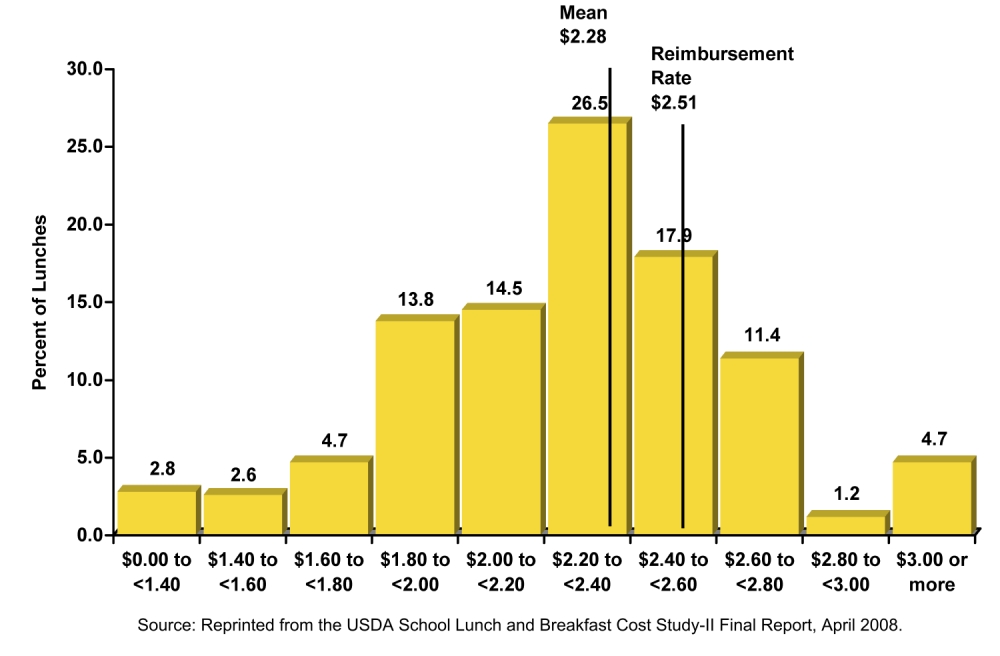
Distribution of Lunches by Reported Cost per Reimbursable Lunch.
How is the National School Lunch Program Working in Indian Country
Child Nutrition Programs, National School Lunch Program
12/9/14
New guidelines for the National School Lunch Program are aimed at
providing the nation’s children with healthy, age-appropriate meals in
an effort to reduce childhood obesity and improve the overall well-being
of kids, especially poor kids, across the country.
A Matter of National Security
The federal government established the school lunch program in the early 1930s to try to prevent widespread childhood malnutrition during the Depression and to support struggling farmers by having the federal government buy up surplus commodity foods. By 1942, 454 million pounds of surplus food was distributed to 93,000 schools for lunch programs that benefited 6 million children.
But when the U.S. joined World War II, the U.S. Armed Forces needed all of the surplus food U.S. farmers were producing. By April 1944, only 34,064 schools were participating in the school lunch program and the number of children being served had dropped to 5 million.
In the spring of 1945, Gen. Lewis B. Hershey, a former school principal, told the House Agriculture Committee that as many as 40 percent of rejected draftees had been turned away owing to poor diets. “Whether we are going to have war or not, I do think that we have got to have health if we are going to survive,” he testified. Within a year, Congress passed legislation to appropriate money to support the program on a year-by-year basis and by April 1946, the program had expanded to include 45,119 schools and 6.7 million children.
In 1946, Congress established a permanent National School Lunch Program (NSLP). In the legislation, adequate child nutrition was explicitly recognized as a national security priority. The program was administered by the states, which were required to match federal dollars. Nutritional standards were set by the federal government, and states were required to provide free and reduced priced lunches to children who could not pay.

Fast-forward half a century. By 2009, the Department of Defense reported that more recruits were being rejected for obesity than for any other medical reason. This was around the same time that First Lady Michelle Obama was taking on childhood obesity as a national health crisis.
Childhood obesity, reports the Centers for Disease Control, has more than doubled in children (to 18 percent) and quadrupled in adolescents (to 21 percent) in the past 30 years. In 2012, more than 30 percent of American children and adolescents were overweight or obese. These children are at increased risk for cardiovascular disease, diabetes, bone and joint problems, sleep apnea, and social and psychological problems such as stigmatization and poor self-esteem, according to the CDC. By 2030, 50 percent of Americans are predicted to be obese, according to the Harvard School of Public Health.
In the American Indian community, the rate of obesity is even higher. In 2010, the Indian Health Service reported that 80 percent of American Indian/Alaska Native adults and about 50 percent of AI/AN children were overweight or obese.

Healthy, Hunger-Free Kids Act
Michelle Obama’s child health initiative included her “Let’s Move!” exercise campaign, the first-ever task force on child obesity and her backing for the Healthy, Hunger-Free Kids Act, which passed Congress with bipartisan support in 2010.
The act set new standards, which went into effect in early 2012, for school lunches. These include reduced calories, reduced sugar and reduced sodium combined with increased fresh fruits and vegetables and whole grains. In some cases, schools’ inability to prepare nutritionally adequate, attractive, kid-friendly meals under the new guidelines has led them to drop out of the NSLP altogether. Despite the fact that as of September 2013, only 524 out of 100,000 schools participating in the NSLP, or one half of one percent had dropped out, news coverage has been extensive, complete with photos of unappetizing meals, accounts of student protests and a good deal of criticism of Michelle Obama, who as the point person for the healthy school lunch initiative, is an obvious target.

But the schools dropping out of the program are mostly schools with few students who qualify for free and reduced-price school lunches. The federal government mandates that schools participating in the NSLP provide free lunches for children from families whose incomes are 130 percent of the poverty level or less. That is, if the poverty level for a family of four is $24,000 per year, then children from families of four whose income is under about $31,200 per year are eligible for free lunches. Reduced-price lunches must be provided for children from families with incomes between 130 percent and 185 percent of the poverty level. So if the poverty level is $24,000 for a family of four, children from families of four earning between $31,200 and $44,400 are eligible for reduced priced lunches. Reduced price lunches may cost no more than $0.40.
According to the National Center for Education Statistics, 68 percent of AI/AN students are eligible for free and reduced-price school lunches, compared with only 28 percent of white students. USDA data indicate that 70 percent of children receiving free lunches through the NSLP are children of color, as are 50 percent of students receiving reduced-price lunches.
The very public criticism of the new guidelines poses a threat to AI/AN and other children of color, as well as poor children in general. If the loudest voices cause the federal government to back down on the nutrition standards, the children who will be most affected are those who rely on school breakfasts, lunches, snacks and summer food programs for a significant portion of their nutrition—that is, poor children, the ones receiving free and reduced-price lunches, as do more than two-thirds of AI/AN children in public and non-profit private schools.

Not everyone is having trouble meeting the new guidelines.
Joe Rice (Choctaw), executive director of the Nawayee Center School in Minneapolis, says his school started serving healthier meals to its 55 American Indian high schoolers long before the new guidelines went into effect. “We’re sponsored by the Minnesota Department of Education so we have a licensed food and nutrition service that allows us instead of buying food from the local district to buy through a caterer who serves healthier food in line with our diabetes initiative. The fresh food from our garden and the healthier food from the caterer mean that we’re addressing one of the two modifiable risk factors for diabetes, which is diet. We’re getting away from sugar and saturated fat and more into healthy whole foods.”
And that’s having an impact. The school screens the kids every year and those who have been with the program for a while “typically have better blood glucose levels, and they report exercising and eating more healthy foods throughout the week. We also see healthier BMIs for the kids who have been in the program longer. Overall, we get good health results.”
The garden is a kid-centered endeavor. The students designed and built the garden and decide what crops to grow. The garden, says Rice, is “reconnecting kids to the earth. I remember the first time we had some stuff from the garden, the kids refused to eat it because it came out of the ground.” It also serves as a means of teaching biology, botany, math and language. “We found that gardening could be the starting point for a very rich curriculum and for cultural preservation and revitalization.”
The STAR School just outside Flagstaff, Arizona, serves about 120 Navajo students in grades pre-K through 8. There, too, gardening is a key component of the nutrition program, although until the school can get its gardens and food safety practices certified by the government, garden produce is used only for cooking classes and community events.

Montour gives an example of the value of having kids grow the food they are going to eat: “We’re on our third year now using our salad bar. When we started putting out different types of vegetables, like beets, the students didn’t really know what beets were and they weren’t really trying it. But then they grew some in our greenhouse. Once they harvested them—those things are really big, about half a pound!—kids were saying ‘What is it?’ and ‘I want to eat it.’ They cleaned it and then we just cut it up right there because they wanted to eat it right there. And we let them because that’s the time for them to try it, when they’re willing.”
Beets have become a salad bar favorite, she says, as have other unlikely vegetables such as kale. Even though the school cannot yet use produce from its own gardens or those of local Navajo farmers, they are able to get local and organic produce through their regular food distributor who works with local producers.
Special Circumstances in Indian Country
Dianne Amiotte-Seidel, Oglala Sioux, project director/marketing coordinator for an ANA grant awarded to the InterTribal Buffalo Council in South Dakota, which is a coalition of 56 tribes committed to reestablishing buffalo herds on Indian lands in a manner that promotes cultural enhancement, spiritual revitalization, ecological restoration, and economic development.
Amiotte-Seidel has already more than met the grant’s requirement that she introduce bison meat, which is much healthier for kids than beef, into eight school lunch programs, but it hasn’t been easy. “You can’t just put buffalo meat in the schools. You have a lot of different steps to take and each state is different,” she says.

Amiotte-Seidel adds, “The biggest obstacle is the requirement to have USDA-certified slaughtering plants, because on the reservations that I’m dealing with, let’s use Lower Brule, for example. Lower Brule is four or five hours away from a certified USDA plant. They have to haul buffalo four to five hours to have USDA certify the meat for the school.”
This is one area where perhaps guidelines should be modified to better fit the unique circumstances in Indian Country and other areas where they present a burden so severe that the NSLP fails to meet its original goal—feeding poor children—as well as it could.
A Matter of National Security
The federal government established the school lunch program in the early 1930s to try to prevent widespread childhood malnutrition during the Depression and to support struggling farmers by having the federal government buy up surplus commodity foods. By 1942, 454 million pounds of surplus food was distributed to 93,000 schools for lunch programs that benefited 6 million children.
But when the U.S. joined World War II, the U.S. Armed Forces needed all of the surplus food U.S. farmers were producing. By April 1944, only 34,064 schools were participating in the school lunch program and the number of children being served had dropped to 5 million.
In the spring of 1945, Gen. Lewis B. Hershey, a former school principal, told the House Agriculture Committee that as many as 40 percent of rejected draftees had been turned away owing to poor diets. “Whether we are going to have war or not, I do think that we have got to have health if we are going to survive,” he testified. Within a year, Congress passed legislation to appropriate money to support the program on a year-by-year basis and by April 1946, the program had expanded to include 45,119 schools and 6.7 million children.
In 1946, Congress established a permanent National School Lunch Program (NSLP). In the legislation, adequate child nutrition was explicitly recognized as a national security priority. The program was administered by the states, which were required to match federal dollars. Nutritional standards were set by the federal government, and states were required to provide free and reduced priced lunches to children who could not pay.
Nawayee Center School in Minneapolis serves 55 American Indian high school students. (Nawayee Center School)
Childhood Obesity EpidemicFast-forward half a century. By 2009, the Department of Defense reported that more recruits were being rejected for obesity than for any other medical reason. This was around the same time that First Lady Michelle Obama was taking on childhood obesity as a national health crisis.
Childhood obesity, reports the Centers for Disease Control, has more than doubled in children (to 18 percent) and quadrupled in adolescents (to 21 percent) in the past 30 years. In 2012, more than 30 percent of American children and adolescents were overweight or obese. These children are at increased risk for cardiovascular disease, diabetes, bone and joint problems, sleep apnea, and social and psychological problems such as stigmatization and poor self-esteem, according to the CDC. By 2030, 50 percent of Americans are predicted to be obese, according to the Harvard School of Public Health.
In the American Indian community, the rate of obesity is even higher. In 2010, the Indian Health Service reported that 80 percent of American Indian/Alaska Native adults and about 50 percent of AI/AN children were overweight or obese.
Nawayee Center School garden
and raised bed. Students built the fence around the garden in the second
year. Since then they have built flower boxes, started doing seed
saving and added recycling and composting. (Nawayee Center School)
Obese and overweight children have access to too many cheap calories
with too little nutritional value, leading to the paradox of
malnourished overweight children. Poor nutrition, often in the form of
too much sugar and other simple carbohydrates, can lead to diabetes,
which is rife in AI/AN communities.Healthy, Hunger-Free Kids Act
Michelle Obama’s child health initiative included her “Let’s Move!” exercise campaign, the first-ever task force on child obesity and her backing for the Healthy, Hunger-Free Kids Act, which passed Congress with bipartisan support in 2010.
The act set new standards, which went into effect in early 2012, for school lunches. These include reduced calories, reduced sugar and reduced sodium combined with increased fresh fruits and vegetables and whole grains. In some cases, schools’ inability to prepare nutritionally adequate, attractive, kid-friendly meals under the new guidelines has led them to drop out of the NSLP altogether. Despite the fact that as of September 2013, only 524 out of 100,000 schools participating in the NSLP, or one half of one percent had dropped out, news coverage has been extensive, complete with photos of unappetizing meals, accounts of student protests and a good deal of criticism of Michelle Obama, who as the point person for the healthy school lunch initiative, is an obvious target.
Nawayee Center School students working in the garden. (Nawayee Center School)
Poor Children Need School LunchesBut the schools dropping out of the program are mostly schools with few students who qualify for free and reduced-price school lunches. The federal government mandates that schools participating in the NSLP provide free lunches for children from families whose incomes are 130 percent of the poverty level or less. That is, if the poverty level for a family of four is $24,000 per year, then children from families of four whose income is under about $31,200 per year are eligible for free lunches. Reduced-price lunches must be provided for children from families with incomes between 130 percent and 185 percent of the poverty level. So if the poverty level is $24,000 for a family of four, children from families of four earning between $31,200 and $44,400 are eligible for reduced priced lunches. Reduced price lunches may cost no more than $0.40.
According to the National Center for Education Statistics, 68 percent of AI/AN students are eligible for free and reduced-price school lunches, compared with only 28 percent of white students. USDA data indicate that 70 percent of children receiving free lunches through the NSLP are children of color, as are 50 percent of students receiving reduced-price lunches.
The very public criticism of the new guidelines poses a threat to AI/AN and other children of color, as well as poor children in general. If the loudest voices cause the federal government to back down on the nutrition standards, the children who will be most affected are those who rely on school breakfasts, lunches, snacks and summer food programs for a significant portion of their nutrition—that is, poor children, the ones receiving free and reduced-price lunches, as do more than two-thirds of AI/AN children in public and non-profit private schools.
Students at the Nawayee
Center School designed and built the garden, and they do all of the
planting, weeding, watering and harvesting. The lush garden supplies
food for the school lunch program. Students have learned to preserve
fruits and vegetables for the winter. (Nawayee Center School)
Successful School Lunch Programs in Indian CountryNot everyone is having trouble meeting the new guidelines.
Joe Rice (Choctaw), executive director of the Nawayee Center School in Minneapolis, says his school started serving healthier meals to its 55 American Indian high schoolers long before the new guidelines went into effect. “We’re sponsored by the Minnesota Department of Education so we have a licensed food and nutrition service that allows us instead of buying food from the local district to buy through a caterer who serves healthier food in line with our diabetes initiative. The fresh food from our garden and the healthier food from the caterer mean that we’re addressing one of the two modifiable risk factors for diabetes, which is diet. We’re getting away from sugar and saturated fat and more into healthy whole foods.”
And that’s having an impact. The school screens the kids every year and those who have been with the program for a while “typically have better blood glucose levels, and they report exercising and eating more healthy foods throughout the week. We also see healthier BMIs for the kids who have been in the program longer. Overall, we get good health results.”
The garden is a kid-centered endeavor. The students designed and built the garden and decide what crops to grow. The garden, says Rice, is “reconnecting kids to the earth. I remember the first time we had some stuff from the garden, the kids refused to eat it because it came out of the ground.” It also serves as a means of teaching biology, botany, math and language. “We found that gardening could be the starting point for a very rich curriculum and for cultural preservation and revitalization.”
The STAR School just outside Flagstaff, Arizona, serves about 120 Navajo students in grades pre-K through 8. There, too, gardening is a key component of the nutrition program, although until the school can get its gardens and food safety practices certified by the government, garden produce is used only for cooking classes and community events.
Seventh and eighth graders at
the STAR School shucking Navajo white corn in the early fall of 2014.
The corn was then shaved and stored in the freezer to be used later.
(STAR School)
Louva Montour (Diné) is food services manager. She says the school
has had no trouble meeting the new guidelines. STAR School has its own
garden and greenhouses, and students also work on a Navajo farm about 20
miles from the school, where they help with planting, watering, weeding
and harvesting. “It really helps that they get hands-on experience
working with food, from planting, even preparing the soil, composting
(Our kids know a lot about composting!), the whole cycle,” says Montour.Montour gives an example of the value of having kids grow the food they are going to eat: “We’re on our third year now using our salad bar. When we started putting out different types of vegetables, like beets, the students didn’t really know what beets were and they weren’t really trying it. But then they grew some in our greenhouse. Once they harvested them—those things are really big, about half a pound!—kids were saying ‘What is it?’ and ‘I want to eat it.’ They cleaned it and then we just cut it up right there because they wanted to eat it right there. And we let them because that’s the time for them to try it, when they’re willing.”
Beets have become a salad bar favorite, she says, as have other unlikely vegetables such as kale. Even though the school cannot yet use produce from its own gardens or those of local Navajo farmers, they are able to get local and organic produce through their regular food distributor who works with local producers.
Special Circumstances in Indian Country
Dianne Amiotte-Seidel, Oglala Sioux, project director/marketing coordinator for an ANA grant awarded to the InterTribal Buffalo Council in South Dakota, which is a coalition of 56 tribes committed to reestablishing buffalo herds on Indian lands in a manner that promotes cultural enhancement, spiritual revitalization, ecological restoration, and economic development.
Amiotte-Seidel has already more than met the grant’s requirement that she introduce bison meat, which is much healthier for kids than beef, into eight school lunch programs, but it hasn’t been easy. “You can’t just put buffalo meat in the schools. You have a lot of different steps to take and each state is different,” she says.
A child at Taos Pueblo school
finished her buffalo entree first! This is one of the schools included
in the ANA grant awarded to the InterTribal Buffalo Council. (Dianne
Amiotte-Seidel)
In order for a school to serve bison, “a tribe has to have enough
buffalo to supply the school for one meal a week or a month, or
whatever, and then they have to have a USDA plant nearby. They have to
be willing to sell the buffalo meat to the school for the price of beef
and they have to be able to have a supplier from a USDA plant take the
meat to the school. The meat needs to bear a child nutrition label. The
school has to be able to have a supply area big enough store the bison
meat they need for the year, since tribes usually only do their harvest
once a year.”Amiotte-Seidel adds, “The biggest obstacle is the requirement to have USDA-certified slaughtering plants, because on the reservations that I’m dealing with, let’s use Lower Brule, for example. Lower Brule is four or five hours away from a certified USDA plant. They have to haul buffalo four to five hours to have USDA certify the meat for the school.”
This is one area where perhaps guidelines should be modified to better fit the unique circumstances in Indian Country and other areas where they present a burden so severe that the NSLP fails to meet its original goal—feeding poor children—as well as it could.
The benefits of free and reduced lunch programs
National School Lunch Program, Summer Food Service Program
April 30, 2016,
0 Comment
ALBERT LEA, Minn. – Thousands of students throughout our area
rely on the fact that they will receive food at school, but many of
those families have a tough time even affording that.
The free and reduced lunch program is a service designed to help those families bridge the gap and allow students to receive a nutritious lunch during the day.
Halverson Elementary School in Albert Lea has seen this need increase over time.
The school has a little more than 350 students enrolled, however of that, 75 percent of them are also enrolled in the free and reduced lunch plan.
It’s a shocking statistic but one that school officials like Principal Nick Sofio, are learning to deal with.
“We’ve grown a little bit from last year to this year, in terms of the number of students who are on the free and reduced lunch,” Sofio says, “but not necessarily significantly, just a small growth.”
Amanda Stender is a single mom who has been a part of this program for the past five years.
With two kids in school, the bills can really add up as she needs to buy two sets of school supplies, school clothes and, school lunches.
Stender says she’s thankful to have this program and doesn’t know what she would do without it.
“I really can’t afford the two of them, so we had an option to apply for it and we applied and we qualified for it.”
However, t’s not just the Albert Lea School district that is seeing these types of statistics.
According to data from the Minnesota Department of Education, there are currently more than 200,000 students eligible for free lunches and another 60,000 eligible for reduced price lunches.
Mason City Public Schools say they have seen their numbers increase from 43 percent in 2009, to 51 percent in 2014.
Along with that, Rochester Public Schools currently have nearly 37 percent of their students enrolled in the program.
Minnesota lawmakers are working to pass a bill that would put $3.5 million toward students who qualify for the 40 cent, reduced-priced meals however, help is still needed for schools which is why Halverson Elementary is partnering with their local Rotary Club to help them raise money.
Eligibility for the free and reduced lunch program is primarily based on the family’s income and to learn more about this service or to see if you might be eligible to apply, visit the Minnesota School Breakfast and Lunch Program.
Lifeline Discount Program Find out if you or somebody you know qualifies for discounted Frontier Services.
Find out if you or somebody you know qualifies for discounted Frontier Services.
You have selected: Minnesota
To receive Lifeline Telephone Service discounts in Minnesota, you must certify that you or someone in your household currently receives benefits from one of these programs:- Medicaid
- Supplemental Nutrition Assistance Program (SNAP) formerly Food Stamps
- Supplemental Security Income (SSI)
- Federal Public Housing Assistance (Section 8)
- Low-Income Home Energy Assistance Program (LIHEAP)
- Temporary Assistance for Needy Families (TANF)/Minnesota Family Investment Program (MFIP)
- National School Lunch Program’s Free Lunch Program (NSL)
- Bureau of Indian Affairs General Assistance
- Tribally Administered Temporary Assistance for Needy Families (Tribal TANF)
- Head Start (Income-Based)
- Food Distribution Program on Indian Reservations (FDPIR)
You must notify Frontier when you are no longer eligible for Lifeline. Lifeline service is a non-transferable government assistance program that provides a discount on the cost of monthly telephone service. Lifeline is limited to one discount per household and only eligible customers may enroll. You must also verify your continued eligibility annually (or as requested) with Frontier. If there is someone else at the address who is receiving a Lifeline discount and you wish to be considered a separate economic unit, the Lifeline Application and proof of eligibility must be submitted along with the Lifeline Household Worksheet. If you wish to change your Lifeline benefit from another carrier to Frontier, you must submit a benefit transfer letter with your application to Frontier.
Download the Lifeline application for the state of Minnesota. (Descargar la aplicación de las instrucciones escritas en español.)
For further information, please contact Customer Service. A Frontier representative will be happy to answer your questions. Call us. We’re here to help.
affordable meal management system automated Point Of Sale (POS) lunch system School Lunch POS School Lunch Software SFSP Summer Food Service Program Summer Food Service Program (SFSP) Technology solutions for the cafeteria and beyond wordware Public School Lunch
Farm to School program means colorful lunch trays
t
 Kate Kompas, kkompas@stcloudtimes.com
FOLEY — State department officials dined with Foley High School
students Tuesday in the cafeteria as they got an up-close look at the
results of the district’s “Farm To School” program. The farmers who were
responsible for the fresh produce being served at lunchtime ate there,
too.
On Tuesday’s menu: chicken, mashed potatoes and gravy with rosemary and thyme right from the school’s garden, along with a homemade roll, squash, watermelon, bananas and more. Patty Donahue, cook manager for grades 4-12, said she based the gravy recipe off one used by the Food Network’s Ina Garten.
Foley is among more than 200 districts statewide in the Farm to School program, which serves half of Minnesota’s students, according to information provided by the state. The Foley district has participated since 2012. Farm to School has awarded money to districts to help them participate in the program; Foley received about $11,000 from the state for fiscal year 2015.
Story continues below.
The Foley school district gets fresh produce from Stoney Brook Farms
and Novak Farms, both near Foley. Representatives from the farms as well
as the Minnesota Department of Agriculture and the Center for
Prevention at Blue Cross and Blue Shield of Minnesota, which awards
grants related to Farm to School, are visiting schools around the state.
The Foley district is buying a tilting braising pan so it can make more meals from scratch, too.
Farm to School means more prep time for kitchen staffers, Foley school service director Cheryl Pick said. The benefits far outweigh the time, though.
“The kids enjoy it, and that’s why we do it,” she said.
School officials said up to 87 percent of high school students take hot meals; Foley High School has about 1,600 students.
Many high school students at lunch Tuesday had banana peels or green strawberry tops on their trays. Students can take unlimited amounts of fruits and veggies.
“You see so much color on their plates,” Foley High School Principal Shayne Kusler said.
Story continues below.
The farms provide everything from sweet corn to kohlrabi for the lunches.
“It’s good to promote the fresh vegetable aspect of it for the kids,” said Mark Chmielewski of Stoney Brook Farm.
Greg Novak of Novak Farm recently sold 48 quarts of strawberries, an 800-pound bin of watermelon and cucumbers to the district. Farm to School is good for his business. His only request: He wishes Minnesota schools could start earlier so Foley could get the best of his harvest, but he likes closing out the season with the district. (And when he was a student at Foley, no, he doesn’t believe he had such healthful choices at lunchtime.)
Ellie Manderfeld, a Foley senior, admitted she likes fruits more than veggies.
“When we have the options, it’s nice,” she said.
Many of the students were busy getting big cups of what looked like ice cream at lunchtime. School officials had to break it to them that it was frozen yogurt.
Follow Kate Kompas on Twitter @copygirlkate, or call her at 259-3620.
On Tuesday’s menu: chicken, mashed potatoes and gravy with rosemary and thyme right from the school’s garden, along with a homemade roll, squash, watermelon, bananas and more. Patty Donahue, cook manager for grades 4-12, said she based the gravy recipe off one used by the Food Network’s Ina Garten.
Foley is among more than 200 districts statewide in the Farm to School program, which serves half of Minnesota’s students, according to information provided by the state. The Foley district has participated since 2012. Farm to School has awarded money to districts to help them participate in the program; Foley received about $11,000 from the state for fiscal year 2015.
Story continues below.
The Foley district is buying a tilting braising pan so it can make more meals from scratch, too.
Farm to School means more prep time for kitchen staffers, Foley school service director Cheryl Pick said. The benefits far outweigh the time, though.
“The kids enjoy it, and that’s why we do it,” she said.
School officials said up to 87 percent of high school students take hot meals; Foley High School has about 1,600 students.
Many high school students at lunch Tuesday had banana peels or green strawberry tops on their trays. Students can take unlimited amounts of fruits and veggies.
“You see so much color on their plates,” Foley High School Principal Shayne Kusler said.
Story continues below.
“It’s good to promote the fresh vegetable aspect of it for the kids,” said Mark Chmielewski of Stoney Brook Farm.
Greg Novak of Novak Farm recently sold 48 quarts of strawberries, an 800-pound bin of watermelon and cucumbers to the district. Farm to School is good for his business. His only request: He wishes Minnesota schools could start earlier so Foley could get the best of his harvest, but he likes closing out the season with the district. (And when he was a student at Foley, no, he doesn’t believe he had such healthful choices at lunchtime.)
Ellie Manderfeld, a Foley senior, admitted she likes fruits more than veggies.
“When we have the options, it’s nice,” she said.
Many of the students were busy getting big cups of what looked like ice cream at lunchtime. School officials had to break it to them that it was frozen yogurt.
Follow Kate Kompas on Twitter @copygirlkate, or call her at 259-3620.
Monday, 18 April 2016
Mora Public School District 332 FAMILY LUNCH ACCOUNT
HOW TO VIEW YOUR FAMILY LUNCH ACCOUNT**
THIS ACCESS IS AVAILABLE ONLY THROUGH YOUR PARENTVUE ONLINE ACCOUNT. (If you do not have a ParentVUE account set up yet, please stop at any one of our schools to fill out a short application, show proof of ID and you will be given an activation key for you to complete the set-up of your online account.) Then contact Barbara Fredrickson in Food Service to obtain your assigned ID/PIN #s for your lunch account access.
- Log into your ParentVUE account and click on the Lunch Account link on the left-hand side of your computer screen.
- This will take you to another view where the words Lunch Account will be in Blue as a hot link-- click on that link.
- The Wordware window for Family Account Login will appear.
- Click in the Username box and enter your Family ID number.
- Click in the Password box and enter your assigned PIN number.
- Click on Sign In.
- Click on the drop-down arrow to choose the correct state. Click on Minnesota to fill in the state box.
- Choose the school district from the drop-down arrow: Mora Public Schools.
- Click on Sign In.
- The school lunch account summary screen will appear with information on your family meal account.
- Scroll to the bottom of the summary screen and click on the statement: " To view a detailed report of transactions, Click Here " to view recent transactions.
- There is a link at the bottom of that page where you may chose to view transactions dating further back by clicking on the " To request prior history transactions, Click Here "
- You can choose the date range in which you want to see your transactions by clicking on the circle in front of the available date ranges.
- Verify the email address where you wish the statement to be sent to and press send request.
If you have any problems or questions about this procedure, please contact Barbara Fredrickson in Food Service by email: Barbara Fredrickson
**Family Lunch Account online access will only be given to custodial parents. If noncustodial parents have lunch account questions, they will need to call or email Barbara Fredrickson directly.
**Family Lunch Account online access will only be given to custodial parents. If noncustodial parents have lunch account questions, they will need to call or email Barbara Fredrickson directly.
Published in Print: March 5, 2014, as Bertrand Weber
Minneapolis Leader Turns School Cafeterias Into 'Real Kitchens'
Bertrand Weber
Focus of Strength: Student Nutrition
Position: Director, Culinary and Nutrition Services
District: Minneapolis Public Schools
Bertrand Weber had devoted his professional life—in boutique hotels
and high-end restaurants—to pleasing the most discerning of palates.But the breaded chicken nuggets and canned fruit swimming in syrup he saw on his son's lunch tray pushed the longtime hotel and restaurant manager to swap a career in stylish hospitality for the decidedly less posh world of school cafeterias.
He was determined to transform what K-12 students in Minnesota eat at school.
"We were pumping our kids with processed food," said Mr. Weber. "I became an angry parent."
He is steadily phasing out prepackaged meals assembled in a central kitchen and trucked to school lunchrooms and replacing them with meals made from scratch and featuring fresh fruit, vegetables, and meats and other ingredients that are locally sourced.
Butternut-squash turkey chili, heirloom-tomato salsas, and fresh salad bars are becoming fixtures in Minneapolis' school lunchrooms.
What makes the ongoing transformation in Minneapolis remarkable is that Mr. Weber has done it with a food-service budget considerably smaller than those of similarly sized districts. When he came on board in January 2012, Minneapolis' food budget was $15.6 million, compared with $23 million across the Mississippi River in the neighboring, and slightly bigger, St. Paul school district.
And he's doing it in a district where most of the 62 schools do not have fully functioning kitchens.
"It's a really smart tactic he's using to raise the image of his program so that participation rates go up and [he can] raise more revenue to do all the things he wants to do," said Jean Ronnei, the chief of operations for the St. Paul district and the vice president of the School Nutrition Association. "For 30 years, if you talked about school food in Minneapolis, you were talking about airline-type food. He is completely changing that, and with it, completely changing people's minds about what food is in that school system."
Personal Mission
Born in Switzerland, Mr. Weber, 57, brings a missionary's zeal to the job of school food. And for very personal reasons.His son, at age 7, was diagnosed with Type 1 diabetes, requiring daily doses of insulin and close monitoring of his food intake.
"I went to lunch with him every day in that first year after his diagnosis," Mr. Weber said. "The last things he needed were exactly the things being served in the cafeteria every day: highly refined carbohydrates and canned, syrupy fruit. I complained endlessly about the food."
A short time later, his son's district—Hopkins, in surburban Minneapolis—launched a search for a new food-services director who had a hospitality background like Mr. Weber's.

—Jenn Ackeman for Education Week
He landed the job. Mr. Weber led the food-services program for three years in the 7,400-student Hopkins district, where he was able to introduce more fresh produce, purchase local food products, and involve students and the community in the planning of menus. He pushed hard to eliminate trans fats in Hopkins, years ahead of the recent federal mandate to so do.
From there, he left for a job overseeing nutrition and culinary standards for a privately owned food-management company that helped more than 180 districts across Minnesota and other Midwestern states bring fresh fruit and vegetable bars to school lunchrooms. He also got involved in the growing movement known as Farm to School and currently serves on the national network's executive committee.
"That was a great opportunity to impact more kids," he said.
Then, in 2011, the Minneapolis district's longtime food-services director retired, and prominent members of the city's local food movement urged Mr. Weber to go after the job.
First, he did some due diligence. He found that lunch participation districtwide was 58 percent, a dismal rate compared with St. Paul, where participation was at 78 percent. Cincinnati, a district of similar size and demographics, had a 70 percent participation rate. There was lots of room to grow, he thought, and the challenge of expanding and improving the meals program within the constraints of a public school district's budget appealed to him.
But he also thought his candor in the job interview might backfire.
"I was very straightforward that if they wanted someone to do the status quo, go right over me," Mr. Weber said. "And I said, if you want me for the job, it's going to be about changing the system for kids."
'A Real Kitchen'
In his first few months on the job, Mr. Weber went face to face with parents and students in multiple community meetings, soliciting their critical feedback."People were appalled by the food service, and I told them I was just as appalled," he said. "I told them some ideas we had for making things better, but I also was very upfront that this was going to take time. I couldn't just flip one switch and go from a food-packing plant to a real kitchen."
For starters, even the district's central kitchen had been stripped of nearly all its cooking equipment in the mid-1990s. There were no ovens. No steamers.
Still, to deliver as soon as possible on promises to bring real, or "true" foods into lunchrooms, Mr. Weber and his team began installing salad bars in some of the city's schools. To pay for the first few, he tapped into his existing budget, but then quickly began seeking grants and other outside sources of revenue to cover the expenses.
As of last month, half the district's schools were offering the fresh-produce carts, which feature items such as spinach, cherry tomatoes, cantaloupe, pears, three-bean salad, and couscous salad.
"It was important for us to get kids off fruit wrapped in plastic packages," he said. "And it was a way to get skeptical parents paying for their kids to eat lunch at school again."
Mr. Weber also began making immediate changes to the menus. Hot dogs were sourced from a local cattle company that raises grass-fed beef and were served on buns baked by school district cooks. And Tater Tot hot dish—a beloved school lunch item in Minnesota—was revamped to be cooked from scratch by the district's head chef in the central kitchen and assembled by school-based cafeteria staff.
But beyond parents, Mr. Weber had two other critical groups to persuade to embrace his vision for real food: students and his food-services staff.
To reel in students—especially hard-to-impress teenagers—he decided to test new recipes and menu items one day a week in select schools. Students at one high school quickly dubbed Thursdays "Real Food Day" and were enthusiastic about many of the new offerings like Asian cole slaw and fresh-baked ciabatta bread.
A year and a half later, lunchroom meals in some high schools have become so popular that students who usually left campus for lunch are staying, but not everyone who wants to eat in the cafeteria can because of time and space constraints.
"We're maxed out in our high schools," he said.
Mr. Weber said the biggest pushback he got initially came from older employees in food services and the union that represents them."Some people worried we were making too many changes that were affecting people who had been here a long time," he said.
To help ease the transition, Mr. Weber offered culinary classes and prep-cook training for staff members who needed support in moving away from the assembly-line approach to food service.
Attracting Customers
Bernadeia H. Johnson, the superintendent in Minneapolis, credits Mr. Weber for "revolutionizing" school lunches in the district."Our students are eating healthier meals that keep them satisfied for a day of quality learning and instruction," she said in a statement. "Lunch menus are full of variety and often introduce students to new and different fresh ingredients, including foods that reflect the ethnicities of our students."
Since Mr. Weber started just over two years ago, overall participation in the district's meals program has grown from 58 percent to 66 percent, most of it among the 35 percent of students who pay full price. Participation among those who qualify for free- and reduced-price meals has also ticked up, from 72.5 percent in 2011 to 87.5 percent. To help pay for the array of food and nutrition initiatives spearheaded by Mr. Weber, lunch prices have been raised by a dime,but only for students who pay full price. Mr. Weber also has begun serving breakfast in classrooms in 20 schools, with plans to expand.
With 30 more salad bars to install and most schools still without kitchens and equipment to do on-site cooking, though, Mr. Weber and his team have hustled to raise private money to keep their momentum going. A local fitness company and General Mills are among the benefactors who are backing the efforts.
He's also found creative ways to buy local, organically raised food products within his budget.
Among the 60,000 pounds of local produce he bought for the district last fall was one farmer's entire kale crop, damaged in a hail storm.
"We were going to chop it up anyway," he said. "And it gave us a healthy vegetable to introduce to our kids."
Mr. Weber has also drawn on his deep connections to local chefs and restaurant owners to persuade them to get involved in recipe development for the district. In turn, the chefs have agreed to endorse the recipes they create for school lunches on their own menus.
"He's getting great support and publicity for what he's doing," said Ms. Ronnei of the St. Paul district. "Chefs endorsing school food? What a message that sends to the community."
Supplemental Nutrition Assistance Program (SNAP)
Schools that participate in School Nutrition
Programs accept applications for free and reduced-price school meal
benefits at any time. Approval is based on comparison of the household’s
income to current U.S. Department of Agriculture (USDA) household
income guidelines. Schools send an Application for Educational Benefits
form to the households of all enrolled students at the beginning of each
school year. A letter accompanies the form and explains school meal
benefits and how to apply.
Households that have already been approved for the following public assistance programs are not required to but can complete an Application for Educational Benefits using case number(s) instead of household income information:
Children approved for these programs may be “directly certified” for free school meals, based on data supplied to MDE by the Minnesota Department of Human Services. For more information, see Direct Certification.
U.S. Department of Agriculture MemosLinks to key USDA memos on Applications-Student Meals are provided below.
Households that have already been approved for the following public assistance programs are not required to but can complete an Application for Educational Benefits using case number(s) instead of household income information:
- Supplemental Nutrition Assistance Program (SNAP)
- Minnesota Family Investment Program (MFIP)
- Food Distribution Program on Indian Reservations (FDPIR)
Children approved for these programs may be “directly certified” for free school meals, based on data supplied to MDE by the Minnesota Department of Human Services. For more information, see Direct Certification.
U.S. Department of Agriculture MemosLinks to key USDA memos on Applications-Student Meals are provided below.
- Disclosure Requirements for Child Nutrition Programs (SP 16-2016)
- Q&A Related to the Independent Review of Applications (SP 44-2014)
- Sharing Aggregate Data to Expand Program Access and Services in Child Nutrition Programs (SP 42-2014)
- Effective Date of Free or Reduced-Price Meal Eligibility Determinations (SP 11-2014)
- Head Start Participation - Questions and Answers (SP 40-2013)
- Categorical Eligibility of Children in Foster Care (SP 17-2011)
- Q&A on Extending Categorical Eligibility to Additional Children in a Household (SP 25-2010)
- E-Rate Audits (SP 04-2009) Disclosure of eligibility information.
- Disclosure of Eligibility Information to the National Assessment of Educational Progress (NAEP) (SP 40-2008)
- Update on Electronic Transactions in Child Nutrition Programs (SP 10-2007)
- Updated Guidance for Homeless Children in School Nutrition Programs (4-04-2002)
-
Types of Case Numbers Reported on an Application for Educational Benefits - 12/30/15
Guidelines to identify eligible Supplemental Nutrition Assistance Program (SNAP), Minnesota Family Investment Program (MFIP) and the Food Distribution Program on Indian Reservations (FDPIR) case numbers used to apply for School Nutrition Programs meal benefits. -
2015-16 Free and Reduced-Price Income Calculator Instructions - 12/14/15
-
2015-16 Free and Reduced-Price Income Calculator - 12/10/15
This tool assists School Food Authorities in determining whether free and reduced-price applications based on income meet eligibility criteria for the 2015-2016 school year. It also includes worksheets for calculating the verification sample method that must be used and tracking the results of verification. -
Online Meal Application Systems - 10/21/15
School Nutrition Programs requirements for schools that have online systems for families to complete electronic Applications for Educational Benefits. -
2015-16 Application for Educational Benefits Packet (version without racial/ethnic section) - 10/13/15
This application packet may be used by a public school or any school with a system in place that has already collected racial/ethnic data on all enrolled students. Otherwise use the standard Application for Educational Benefits Packet. -
2015-16 Application for Educational Benefits - 8/14/15
Household letter, instructions and Application for Educational Benefits. -
2015-16 Household Income Guidelines - 7/8/15
-
Application for Educational Benefits – Procedures for Approval/Denial - 7/6/15
-
2015-16 Household Income Guidelines and Application Requirements - 6/11/15
-
Minnesota Health Care Programs - Notification Requirement - 6/8/15
Includes instructions on how to use the Minnesota health care programs flyer to meet the notification requirement. -
Minnesota Health Care Programs Notification (flyer - Spanish) - 5/27/15
School districts can use this flyer to notify families about free or low-cost health insurance that is available through Minnesota Health Care Programs or MinnesotaCare. -
Minnesota Health Care Programs Notification (flyer - English) - 5/27/15
School districts can use this flyer to notify families about free or low-cost health insurance that is available through Minnesota Health Care Programs or MinnesotaCare. -
Approval/Denial Letter for School Meal Benefits - 5/26/15
Used to notify households of approval or denial for free or reduced-price school meals. -
Translations of Application for Educational Benefits - 6/4/14
-
Option to Approve Applications Back to Receipt Date - 5/14/14
-
Electronic File Storage of Scanned Meal Applications - 2/25/14
-
Applications and Rosters - 11/28/11
Instructions for maintaining applications and rosters.
School Lunch Software
Sunday, 17 April 2016
National School Lunch Program (NSLP) Department of Agriculture
The National School Lunch Program is a federally assisted meal program
operating in over 101,000 public and non-profit private schools and
residential child care institutions. It provides nutritionally
balanced, low-cost or free lunches to more than 31 million children each
school day in 2009. In 1998, Congress expanded the National School
Lunch Program to include reimbursement for snacks served to children in
afterschool educational and enrichment programs to include children
through 18 years of age.
The U.S. Department of Agriculture's (USDA) Food and Nutrition Service administers the program at the federal level. At the state level, the National School Lunch Program is usually administered by state education agencies, which operate the program through agreements with school food authorities.
The National School Lunch Program provides a federal cash and commodity support for each qualified meal and snack served to students. For school year 2009-2010, a subsidy of $2.7 for each lunch served to students eligible for a free lunch, $2.3 for each eligible reduced-price lunch, and $0.3 for each lunch served in the paid category. In 2009, the National School Lunch Program spent $8.9 billion to operate the Program.
Agency Accountable Official: Kevin Concannon, Under Secretary for Food, Nutrition, and Consumer Services, U.S. Department of Agriculture.
Current
$8.9B
Total Payments (Outlays)more info
$1.5B
Improper Paymentsmore info
16.3%
Improper Payment Ratemore info
2011
15.8% Improper Payment Rate Target more info
All amounts are in billions of dollars
Program Comments
Food and Nutrition Service (FNS) relies on periodic nationally-representative studies to produce estimates of improper payments in the National School Lunch Program and School Breakfast Program. The Access, Participation, Eligibility, and Certification (APEC) Study created the first-ever nationally-representative estimate of payment errors in the school meals programs, for school year 2005-06. The President’s 2011 budget requests funding for an update to the study for 2012-13.
FNS is working toward a way to depict the percentage of errors by type –
certification and non-certification errors – that could be provided to
the public. Additional information on the program is also provided
annually in the USDA Performance and Accountability Report.
End Summer Child Hunger Now!

nata_vkusidey via Getty Images
Spring is almost in full swing and summer is just around the corner.
Millions of children in America can’t wait for summer vacation, but for
millions of poor children who rely on school meals it’s a mixed
blessing.
I qualify for free and reduced lunch. I can get a free breakfast, I can get like a muffin, juice, anything like that, in the morning, and then lunch, I don’t have to pay, so I can get whatever I wanted for lunch. So I’ve always been able to eat at school for lunch and breakfast.
Hunger doesn’t
take a summer vacation and poor children like Linda who rely on free and
reduced price breakfast and lunch during the school year to keep the
wolves of hunger at bay face a long summer of food deprivation. “It
was hard without school during the summer, but being able to qualify
for something like food stamps or having a food pantry near us, that
helped a lot,” Linda says, but at the end of the month, “it was kind of
like a hit-or-miss kind of situation.”
Hit or miss.
No child in rich America should go hungry this or any summer,
especially when 100 percent federally funded summer feeding programs are
available if local officials and communities apply for or use them. But
more than 1 in 4 families with children are food insecure and
struggling to keep food on the table. The federal Summer Nutrition
Programs could help millions more children escape hunger this summer by
providing meals if responsible adults act now. The need is urgent.
Although 19.7 million children received free or reduced price lunches
during the 2013-2014 school year, only 3.2 million children – 16.2
percent – participated in the Summer Nutrition Programs.
If local school
boards, community groups, faith congregations, mayors, and county
representatives act now, they should be able to get 100 percent
federally funded Summer Nutrition Programs in their area or add more if
there already are some summer food sites. The federal Summer Food
Service Program and the “Seamless Summer” option offered through the
National School Lunch Program are designed to replace the regular school
year breakfast and lunch programs. Meals provided through the Summer
Nutrition Programs also can link children without summer learning
opportunities, camps or other costly options to educational and
recreational programming to keep them learning, active and safe during
school vacation. Summer feeding programs also create jobs for food
preparers, servers, bus drivers and others.
Schools,
community recreation centers, playgrounds, parks, places of worship, day
and residential summer camps, housing projects, migrant centers, and
Native American reservations are among places that can serve as summer
feeding program sites. Many more sites are needed to fill the summer
hunger gap for millions of children. Far too many communities have no
sites at all or have sites difficult for children without transportation
to reach. Check in now with your school officials, mayors and county
executives to learn what they are doing to prevent childhood hunger.
Some questions to ask include:
- How many children receiving school year breakfasts and lunches will be served by Summer Food Service Programs? What steps have they taken or will they take immediately to get more summer feeding sites up and running?
- How are parents notified about free summer food options?
- Are there district school buses that could be outfitted to deliver summer meals to inaccessible rural areas?
- How many weekend and holiday meal backpacks are provided to children within the Summer Food Service Programs? Has your school district reached out to seek community support for these backpacks?
- In districts with large percentages of children in housing projects, have you or local officials asked housing authorities to make sure they get food to hungry children?
- Are faith communities and service organizations with kitchens in your community aware of the 100 percent federally funded resources and planning to provide summer meals this summer? Do they know about the Children’s Defense Fund’s Freedom Schools® program that provides summer reading enrichment and food to stop summer learning loss and hunger among low-income children?
The Department
of Agriculture (USDA) has been working very hard to reach more children
and is testing exciting new ways to help overcome barriers blocking
summer meals for hungry children. Some communities are using mobile vans
to transport meals. Others use electronic benefit transfer (EBT) cards
to transfer money to help families purchase extra food for children in
the summer. When 4.9 million households, including 1.4 million with
children, had no cash income in fiscal year 2014 and depended
only on food stamps to stave off hunger, every public official,
congregation, and school system needs to use every tool available to
help keep children from going hungry over three long summer months.
Check the Summer Meals Toolkit
on the USDA’s Food and Nutrition Service’s Summer Feeding Service
Program website to learn more about becoming a Summer Meal Champion in
your community or call the National Hunger Hotline at 1-866-348-6479.
There is no reason why there should be a single hungry child in America.
Please act now before the school year ends to allow millions of
children to take a real school vacation without hunger pains.
School Lunch Software Demo contact Wordware Inc.
Subscribe to:
Posts (Atom)